
ComfyUI Extension: Deno Custom Nodes
Run ComfyUI workflows without the setup
No installs, no CUDA version roulette, no GPU sitting idle on your bill. Bring a workflow and run it in the browser.
Korean-friendly practical custom nodes for ComfyUI
Looking for a different extension?
Custom Nodes (21)
- (Deno) Advanced Image Source Loader
- (Deno) Local LLM Reviewer
- (Deno) Bernini Prompt Guide
- (Deno) Ideogram Director
- (Deno) Image Compare
- (Deno) Local LLM Loader
- (Deno) LTX Model Loader
- (Deno) LTX High resolution Tiled Sampler
- (Deno) Easy Model Download Helper
- (Deno) LTX Multi LoRA Loader
- (Deno) LTX Prompt Guide
- (Deno) LTX Sequencer
- (Deno) LTX Tiled Spatial Upscaler
- (Deno) Multi Image Loader
- (Deno) Multi LoRA Loader
- (Deno) Prompt Text
- (Deno) Resize Box
- (Deno) RTX Video Super Resolution
- (Deno) RTX Video Super Resolution (2 Pass)
- (Deno) Video Compare
- (Deno) Video Preview
README
Deno Custom Nodes
English | 한국어 | 日本語 | 简体中文 | Español | Português | Português (Brasil) | Bahasa Indonesia

You can use, study, modify, and redistribute this repo under GPL-3.0.
DENO-owned nodes, docs, examples, workflows, and project-local assets in this repo are released under GNU GPL v3.0 (GPL-3.0-only). Commercial use is allowed, but distributed modified versions must follow GPL-3.0 and preserve the required license and copyright notices.
Third-party models, checkpoints, LoRAs, libraries, tools, and services keep their own licenses and terms. If a workflow uses a specific model or asset, check and follow that license before sharing or selling outputs.
Practical ComfyUI custom nodes focused on fast real-world workflow improvements. This repo is built for global creators and production workflows, with a focus on practical UX and reliable daily use.
Most Deno nodes include a small green i button in the top-right corner for quick node info without leaving the ComfyUI canvas. If a newer Deno Custom Nodes version is available, the button turns yellow and shows a small ! badge.
The pack also includes lightweight frontend/browser helpers such as DENO Visual Fold, optional DENO Floating Tools for Free VRAM, ComfyUI Stable update checks, and GPT/Gemini-ready Error Help reports, the no-install Video Compare page, the Video to GIF/WebP converter page, and the 한국어 전용 디스코드용 영상 / 이미지 압축 page.
Release Notes
Public updates are tracked in CHANGELOG.md. GitHub Releases should use the same short format, with optional notes hidden in collapsible sections.
Web Tools
Run these directly in your browser:
- DENO Video Compare - compare two rendered videos with slider, side-by-side, difference, and toggle views.
- DENO Video to GIF/WebP - trim, crop, resize, and export short clips as GIF or smaller WebP files.
- DENO 디스코드용 영상 / 이미지 압축 - 영상이나 이미지를 줄여 가능하면 10MB 이하 디스코드용 파일로 저장합니다.
DENO Visual Fold

DENO Visual Fold is a visual-only cleanup helper for large ComfyUI graphs. It is enabled automatically when the latest Deno Custom Nodes package is installed or updated.
Select two or more nodes and the native ComfyUI selection toolbar shows a readable green Fold badge. Click it to collapse the selected nodes into one compact visual group; use Unfold to restore them.
You can also select one normal ComfyUI group and use Fold Group to collapse the nodes inside that group while keeping the workflow logic untouched. When two or more groups are selected, the same toolbar adds readable Align badges for left/right/top/bottom alignment and horizontal/vertical spacing.
This is different from ComfyUI Subgraph. Subgraph moves nodes into a child graph, which can be powerful, but it may not be ideal when a workflow depends on keeping Get / Set nodes or parent-child graph structure visible in the main graph. Visual Fold is meant for simple visual organization only. It does not turn the selected nodes into a subgraph or change the workflow logic.
DENO Floating Tools
DENO Floating Tools is an optional helper under Settings > DENO > Tools. It is off by default.
When enabled, it adds a small draggable DENO icon to the ComfyUI screen. The panel can free ComfyUI VRAM through ComfyUI's built-in memory cleanup endpoint, show read-only current/latest status for the ComfyUI Stable core release, and open an Error Help report when a run fails.
Error Help creates a GPT/Gemini-ready report with the current workflow, Python executable and environment type, package versions, GPU details, recent traceback/log context, and custom node summary. It is read-only, opens a report window first, and copies only when you click Copy Report. Common secrets such as tokens, cookies, passwords, private keys, and URL credentials are masked before copy.
Floating Tools does not install, update, restart, repair, or modify workflows.
Included Nodes
(Deno) Ideogram Director
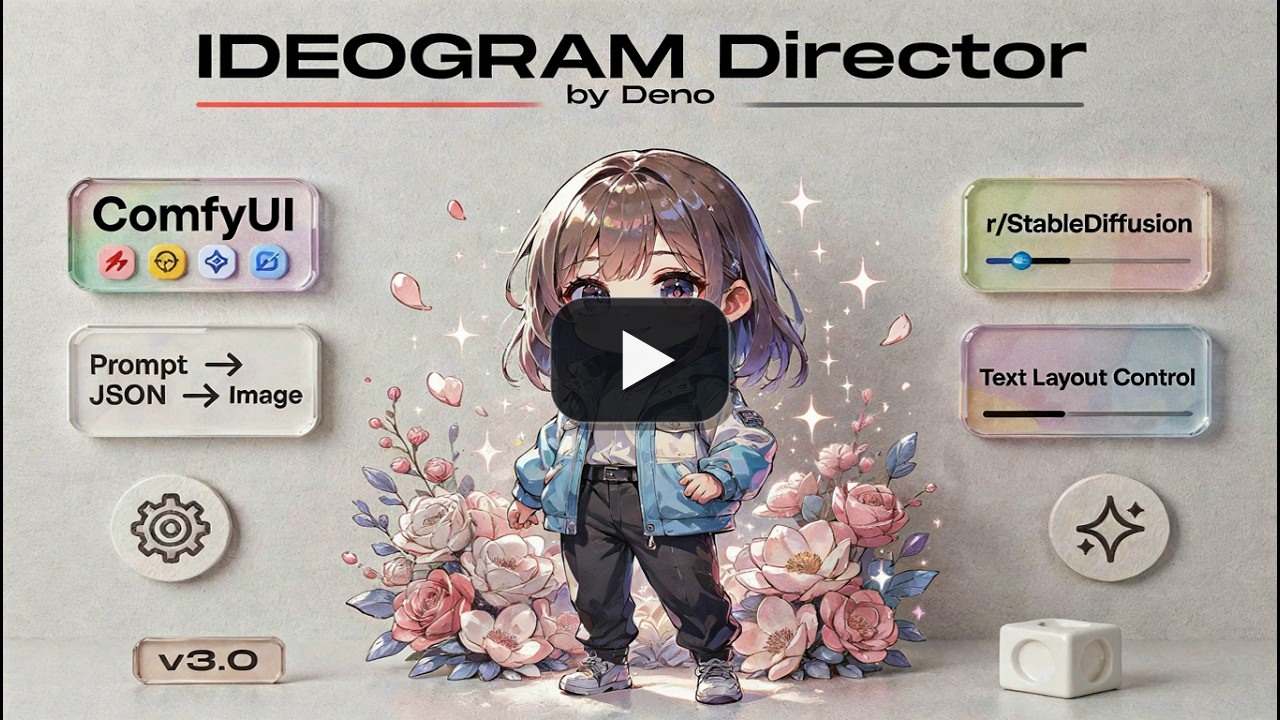
Visual Ideogram 4 prompt builder for structured JSON captions and bbox layout work.
Main features:
- draw and edit bbox regions directly on the ComfyUI canvas
- import JSON prompts from a Local LLM Loader or other STRING source
- ask before replacing an existing board, or switch to always replace
- reject malformed JSON clearly instead of passing broken prompt text downstream
- style and layout preset galleries with lightweight preview thumbnails
- Language view for reading and editing board descriptions in your language while final output stays model-ready English. Literal TEXT box words such as signs, logos, and headlines are preserved exactly
- outputs:
prompt,width,height,seed,bboxes
(Deno) Resize Box
Resolution helper and image resize node for ComfyUI.
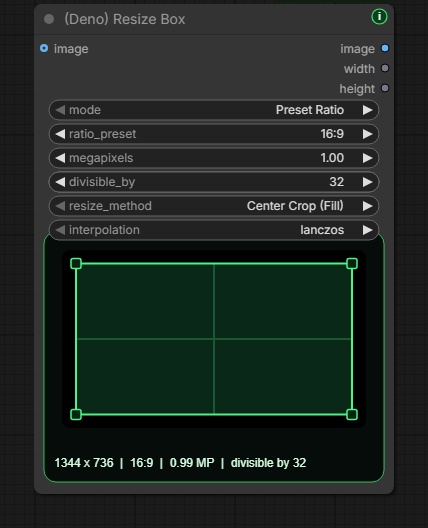
Main features:
Preset RatioandManual Inputmodes- common ratio presets
- megapixel-based size calculation
divisible_byalignmentCenter Crop (Fill)andFit (Letterbox/Pillarbox)resize modeslanczosdefault interpolation- live ratio preview inside the node
- outputs:
image,width,height
(Deno) Multi Image Loader
Minor-upgrade multi-image loader designed for batch guide workflows.
Inspired by the original workflow ideas from WhatDreamsCost, then adapted and refined for the Deno workflow style.
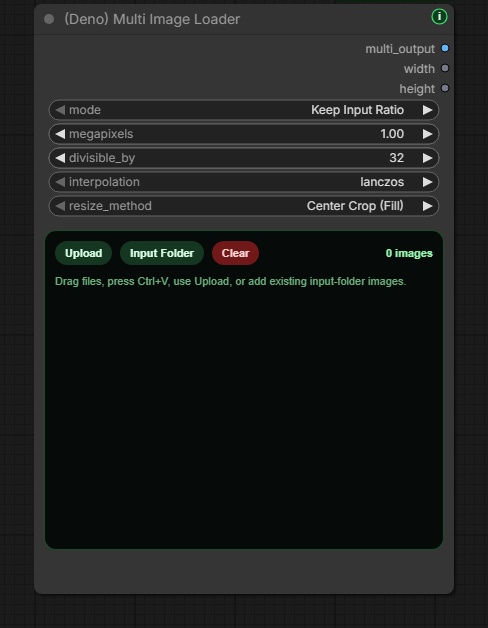
Main features:
- scrollable fixed-height gallery instead of endlessly growing node height
- drag reorder with stable placeholder insertion
- upload button, drag-and-drop upload, and paste image support
Input Folderbrowser for reusing existing ComfyUIinputimages- input subfolder browsing with folder tiles, double-click navigation, and a
Parentbutton - nested input images can be added while preserving their ComfyUI subfolder paths
- newest-first input image sorting based on file modified time
- responsive input-folder thumbnails for smoother browsing with many images
Keep Input Ratio,Preset Ratio, orManual Inputsize mode- ratio preset, megapixels, divisible-by sizing, or direct width/height control
- resize method and interpolation selection
- outputs:
multi_output,width,height - optional crop or fit resizing during export
(Deno) Advanced Image Source Loader
Advanced image source loader for workflows that need external folders, local file paths, web image URLs, and mixed-size image-list output.
This is a separate advanced node. The standard (Deno) Multi Image Loader remains the simpler recommended option for normal ComfyUI input folder workflows.
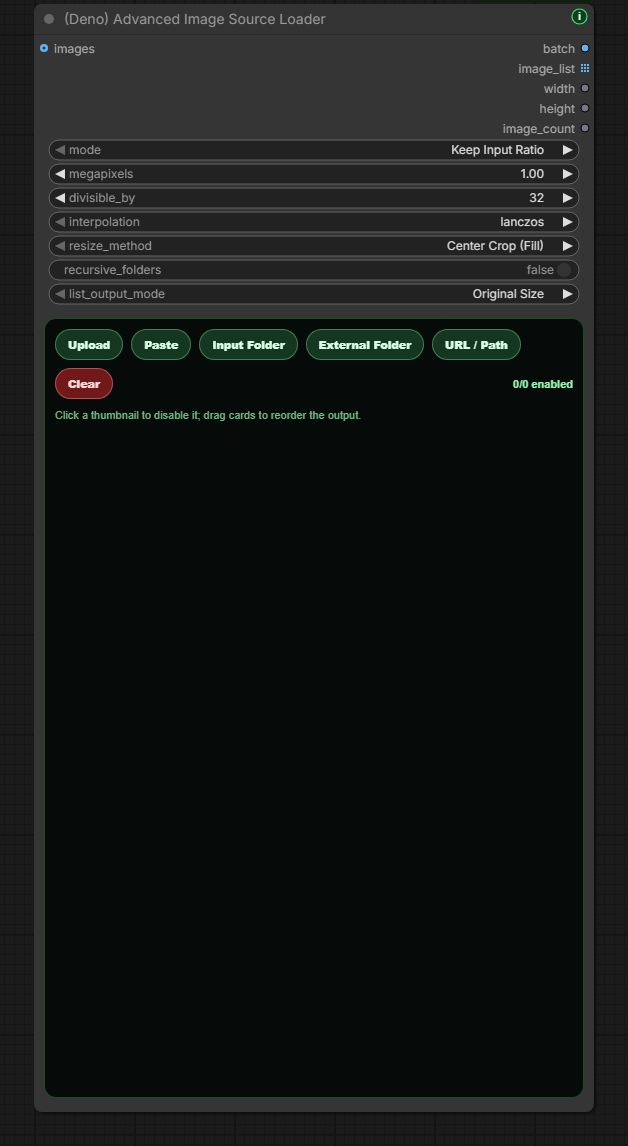
Main features:
- keeps the familiar Deno image-loader gallery workflow
- supports existing ComfyUI
inputfolder browsing - supports external local folder paths outside the ComfyUI
inputfolder - supports folder tiles, nested-folder browsing, and a
Parentbutton - supports
URL / Pathinput for web image URLs, absolute local image paths, and local folder paths - supports upload, drag-and-drop, paste, and browser folder upload where the browser allows it
- includes a visible
Pastebutton plus normal Ctrl+V image paste - click thumbnails to disable/enable sources without deleting them
- drag thumbnail cards to reorder output sequence
- the gallery expands vertically when the ComfyUI node is resized
- thumbnails use a masonry-style flow so mixed portrait/landscape references are easier to scan
Load Pathreads an external folder directly without first importing it into ComfyUIinputUpload Folder...is an optional browser upload/import helper, not required for external path loadingrecursive_foldersoption for loading nested folder imagesKeep Input Ratio,Preset Ratio, orManual Inputsize mode- ratio preset, megapixels, divisible-by sizing, or direct width/height control
- resize method and interpolation selection, including center, top, or bottom crop fill modes
- optional
imagesinput can chain an upstream image batch/list into the same output stream - outputs a resized
batchimage tensor for normal batch workflows - outputs
image_listfor workflows that need per-image list handling Original Sizelist mode can preserve mixed source resolutions inimage_listMatch Batch Sizelist mode makesimage_listmatch the resized batch dimensions- outputs:
batch,image_list,width,height,image_count
(Deno) Image Compare
Visual A/B comparison node for quickly checking two images on the ComfyUI canvas.
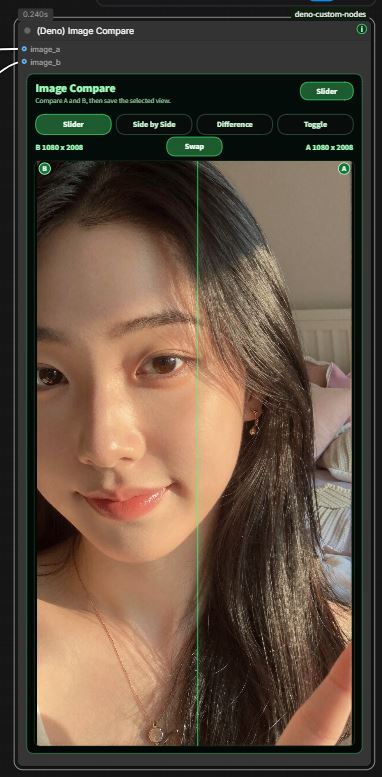
Main features:
- compares
image_aandimage_bdirectly inside the node - modes:
Slider,Side by Side,Difference, andToggle - hover-move slider interaction for fast before/after inspection
- visible A/B labels and a
Swapbutton for checking either direction - resizes the internal preview area with the node so portrait and landscape images stay readable
- visual-only node with no output connection, keeping the graph cleaner when the comparison is just for inspection
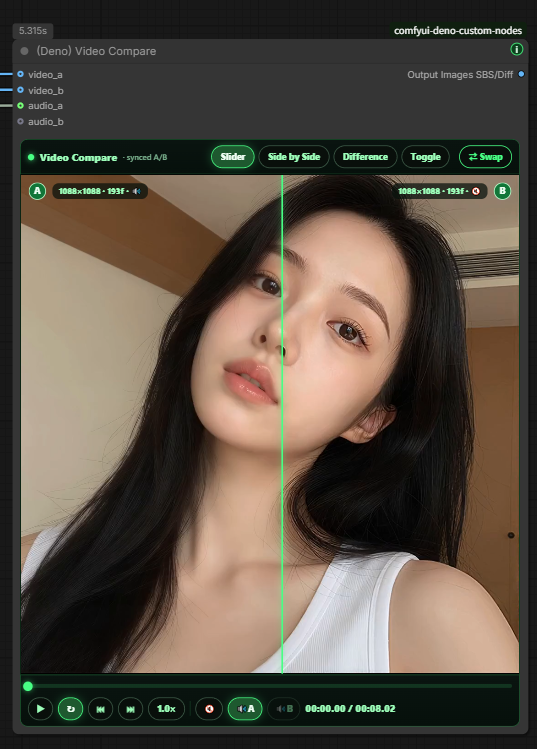
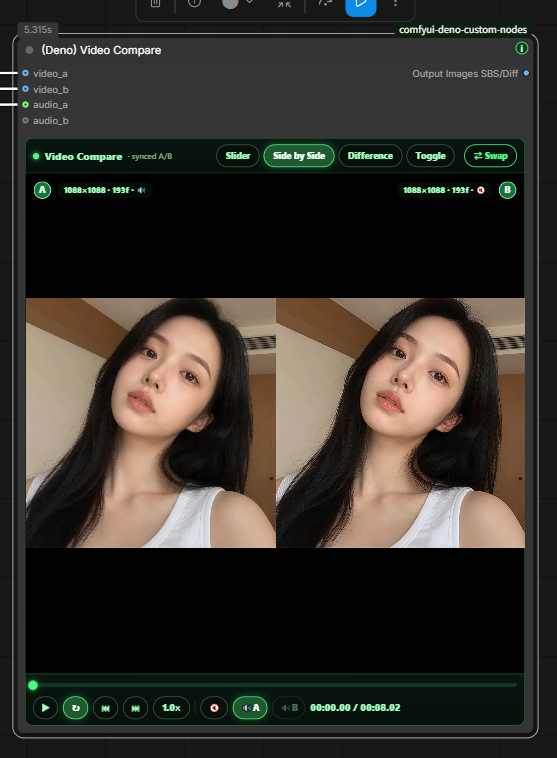
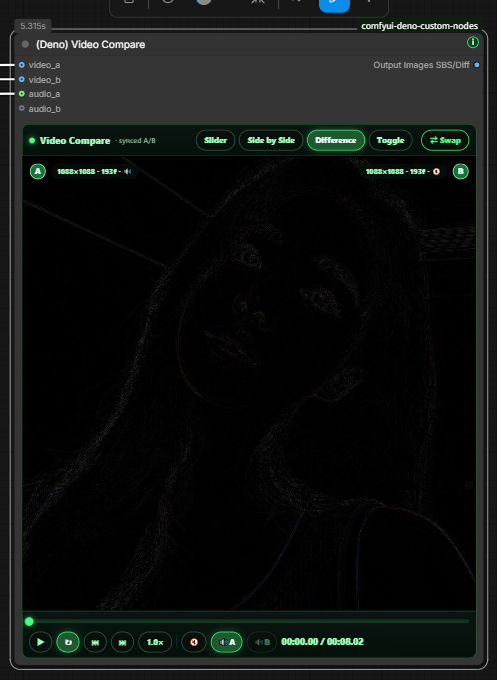
(Deno) Video Compare
Visual A/B comparison node for videos, built for checking upscale and FPS-interpolation results directly on the ComfyUI canvas. All compositing is pure tensor work — no external encoder. The in-node player draws a downscaled WebP frame sequence on a <canvas> on a virtual clock (so A/B stay frame-exact) and plays audio via WebAudio; the files are written to ComfyUI's temp dir and served by the existing /view route, then auto-cleared on restart.
Main features:
video_a/video_b(IMAGE batches) and optionalaudio_a/audio_b(AUDIO, e.g. from VHS Load Video)- modes:
Slider,Side by Side,Difference,Toggle(freeze-frame A/B flip), plusSwap - hover-move slider, click = play/pause, scrub bar, frame step, speed, loop; hover the preview to hear the selected side
- shared timeline: both sides play over the same duration, so an upscale (same frame count) stays frame-locked while an FPS-interpolation result (e.g. RIFE 24 to 48) just looks smoother at the same length
- node resizes to the clip aspect; wheel and middle-drag are passed to the ComfyUI canvas
🏷 Output Badgestoggle: optionally adds A/B + resolution badges to the saved output (off by default; the in-node preview always shows them)comparison: full-resolution lossless IMAGE output of the chosen mode (Slider / Side by Side / Difference / Toggle), ready to wire into a save/encode node such as VHS Video Combine
Too heavy to run the node? Use the no-install browser tool: https://deno2026.github.io/comfyui-deno-custom-nodes/video-compare/ (also linked at the bottom of the node).
(Deno) Video Preview
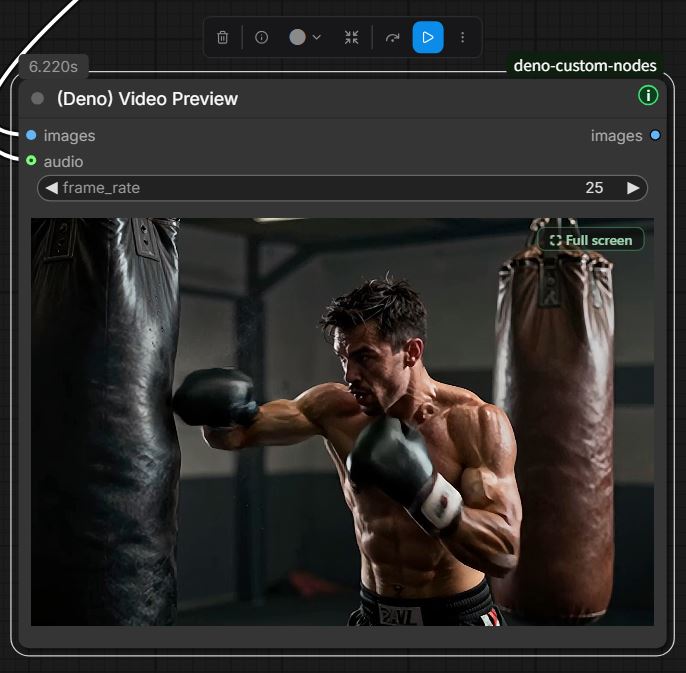
Drop-in, full-resolution preview for checking real encoded output at any point in a graph. It encodes the actual H.264 video at the original resolution in-process with PyAV (no external process is launched) using +faststart so the browser plays it inline reliably, then passes the images straight through — so you can insert it inline at multiple sampling points without branching the wire.
Main features:
images(IMAGE batch) in,imagesstraight-through out,frame_rate, and an optionalaudioinput that is muxed into the preview as AAC (tolerant of dict / object /(waveform, sr)AUDIO and[C,N]/[N,C]shapes; if audio can't be used it is logged and the video still previews)- clean auto-looping in-node player like the VHS preview: no control chrome, hover to hear audio, click = play/pause, a Full screen button, and the wheel is passed through to the ComfyUI canvas
- a compact top-left info badge shows the current preview's resolution, FPS, frame count, and duration
- the node fits the clip aspect and stays fitted as it is resized
- each node reuses one temp file, overwritten every run, so heavy iteration never piles up temp storage
- needs PyAV (
pip install av); if it is missing the node shows a clear one-line install hint instead of failing the graph
(Deno) RTX Video Super Resolution
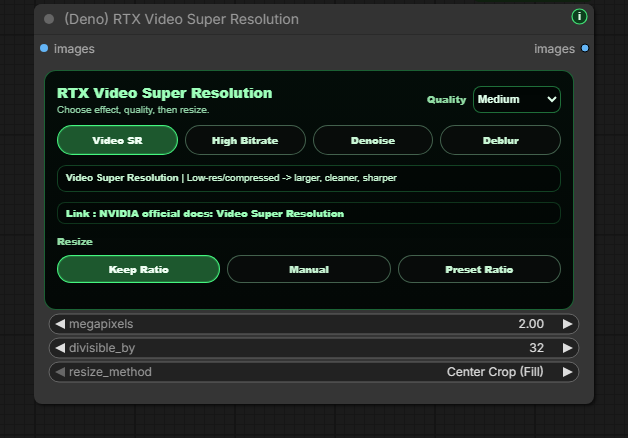
Optional Windows/NVIDIA RTX Video Super Resolution helper node for users who want to try NVIDIA VFX inside ComfyUI without manually hunting for the right Python environment.
This node is intentionally separate from the core Deno nodes. It only imports NVIDIA VFX during upscale execution, so normal Deno node installs do not require NVIDIA VFX. ComfyUI Manager installs the node pack without auto-installing NVIDIA VFX.
Beginner install flow:
- Install or update
deno-custom-nodes, then start ComfyUI. - Add
(Deno) RTX Video Super Resolutionand run it once with an image. - If NVIDIA VFX is missing, close every ComfyUI window/process.
- Click the node's
How to installbutton. - Follow the visual web install guide: download the ZIP from that page, move it into
ComfyUI\custom_nodes\deno-custom-nodes\tools, extract it there, and runinstall_rtx_vfx.batfrom the extracted installer files inside thattoolsfolder. - If the BAT asks
Install RTX VFX here?, typeYonly when the shown Windows path is inside the ComfyUI app you just closed. If it looks wrong, typeNand stop. - Wait for the green
INSTALL COMPLETEmessage. - Restart ComfyUI completely, then use
(Deno) RTX Video Super Resolutionagain.
For the full beginner-friendly visual walkthrough, open the DENO RTX VFX install page.
If a tutorial video tells you to open the tools folder after installing from ComfyUI Manager, open tools/OPEN_INSTALL_GUIDE.txt; it points to the same current install page.
Official NVIDIA references:
Mode guide:
| If your image is... | Use |
| --- | --- |
| small, low-res, or compressed | VSR |
| already clean, but needs a larger sharper output | High Bitrate |
| noisy or grainy | Denoise |
| soft, out of focus, or mildly blurred | Deblur |
Main features:
- uses NVIDIA's official
nvidia-vfx/nvvfx.VideoSuperRespackage path - links from the node UI to NVIDIA's official Video Super Resolution documentation
- shows a compact RTX panel with effect buttons, a separate quality selector, a mode-coach line, and only the resize controls that apply to the selected effect
- single-pass and 2-pass RTX panels pass mouse-wheel scrolling through to the ComfyUI canvas, so normal canvas zoom still works while the pointer is over the node
- installer targets the Python used by the current ComfyUI install
- installer refuses to continue if ComfyUI is still running with that Python
- installer asks before installing into the detected Python
- installer stops if no NVIDIA GPU is detected unless the user explicitly overrides the check
- installer reinstalls
nvidia-vfxcleanly when the user confirms the target Python - installer first verifies the normal
nvvfxpackage path used by the current ComfyUI Python - installer uses the ASCII Windows runtime fallback only when the normal
nvvfxpath fails verification - node startup prefers the recorded ASCII fallback path only when that fallback was actually selected
- if another NVIDIA VFX native module is already loaded from a conflicting path, the node stops and asks for a full ComfyUI restart instead of trying to reload the native extension
- installer verifies that NVIDIA's
VideoSuperReseffect can actually be created after install - if NVIDIA VFX reports an unsupported runtime feature, the node shows a readable GPU/driver/runtime-path message instead of a raw stack trace
- if NVIDIA Broadcast/NGX VFX DLLs from another RTX node are already loaded, the node reports that native runtime conflict separately from GPU/driver support
- if another Broadcast-based RTX node works while DENO fails, treat it as a native runtime conflict, not proof that the DENO install is broken
- keeps the installer BAT and ZIP on GitHub instead of inside the Manager package, while the node UI provides a
How to installbutton that opens the visual web install page plus aCopy stepshelper - keeps a small
tools/OPEN_INSTALL_GUIDE.txtfile in Manager installs so thetoolsfolder still exists for users following older tutorial videos - exposes four clear effect buttons: Video SR, High Bitrate, Denoise, and Deblur
- shows a compact mode coach line that explains the selected effect in plain language
- keeps Low, Medium, High, and Ultra quality as a separate selector
- for Video SR and High Bitrate, supports
Scale,Keep Ratio,Manual, andPreset Ratioresize choices Keep RatioandPreset Ratiouse target megapixels;Manualuses width and height- exposes
divisible_byalignment for resizable modes, with1as the default so standard video sizes such as 1920x1080 stay exact - higher alignment values such as
32remain available when a workflow specifically needs forced multiple-of-N output - shows
Center Crop (Fill)/Fit (Letterbox/Pillarbox)when a manual, preset-ratio, or aligned keep-ratio resize can change aspect ratio DenoiseandDeblurkeep the original size and hide resize controls, matching NVIDIA's same-size VSR modes- shows resize controls only when they apply to the selected effect
- Easy Upscale outputs:
images
(Deno) RTX Video Super Resolution (2 Pass)
Two-pass RTX finishing node for full video workflows. It can run an optional same-size Denoise or Deblur pass first, then an optional VSR or High Bitrate upscale pass.
Example workflow:
Main features:
- includes both
Low System MemoryandHigh System Memorylanes in the example workflow - the low-memory lane uses VHS Meta Batch so longer videos can be processed in smaller frame chunks
- uses
VHS_VideoInfoSourceto carry the source FPS intoVHS_VideoCombine - preserves source audio through the VHS load/combine path
- useful when finishing actual encoded video outputs, not just testing a single image batch
- outputs:
images
(Deno) LTX Sequencer
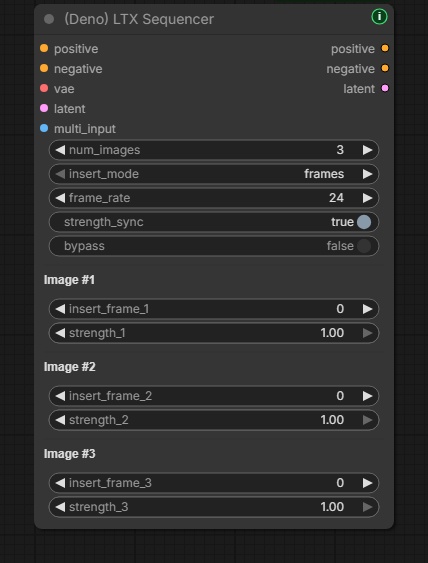
LTX guide sequencer tuned for multi-image workflows.
Inspired by WhatDreamsCost's LTX workflow approach, with Deno-side adjustments focused on day-to-day usability.
Main features:
- works with the batch output from
(Deno) Multi Image Loader - auto-fills
num_imagesfrom the connected loader when possible - keeps the existing sync-style workflow
- allows only
strengthvalues to break out into manual control when needed bypassswitch passespositive,negative, andlatentthrough unchanged for quick A/B tests
(Deno) LTX Model Loader
One compact loader for the common LTX 2.3 model-loading patterns.
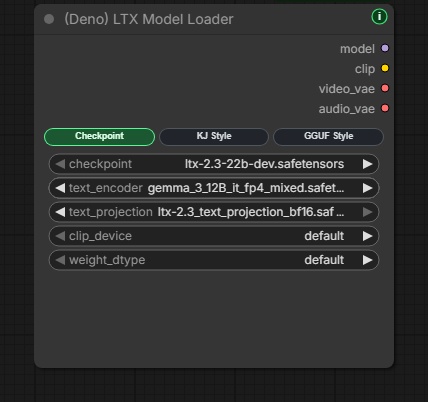
Main features:
Checkpoint Style,KJ Style, andGGUF Stylemodes- outputs:
model,clip,video_vae,audio_vae - uses ComfyUI's built-in checkpoint / diffusion / DualCLIP loading paths where possible
- uses KJNodes
VAELoaderKJfor split video/audio VAE workflows - uses ComfyUI-GGUF UNet loading for GGUF workflows
- includes clearer dependency errors and an audio VAE compatibility fallback for mixed ComfyUI/KJNodes environments
(Deno) LTX Tiled Spatial Upscaler
Helper for high-resolution LTX video-latent second passes. It splits each frame into overlapping spatial tiles, runs the LTX latent spatial upscaler per tile, and blends the result back into one latent.
Use it on video-only LTX latents. If your workflow carries combined video/audio latents, separate the audio path first and rejoin it after the tiled video pass.
(Deno) LTX High resolution Tiled Sampler
Sampler for high-resolution LTX AV refinement passes. It keeps one global sampler trajectory while video predictions are evaluated through overlapping spatial tiles and fused before the sampler update.
The full audio latent is passed to every video tile as context, while the returned audio latent is kept unchanged in freeze mode.
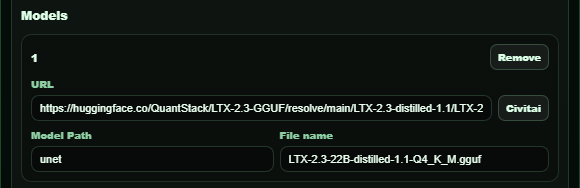
(Deno) Easy Model Download Helper
Preset-based setup helper for recommended model file sets. The first built-in preset is the LTX 2.3 8GB VRAM GGUF starter set.
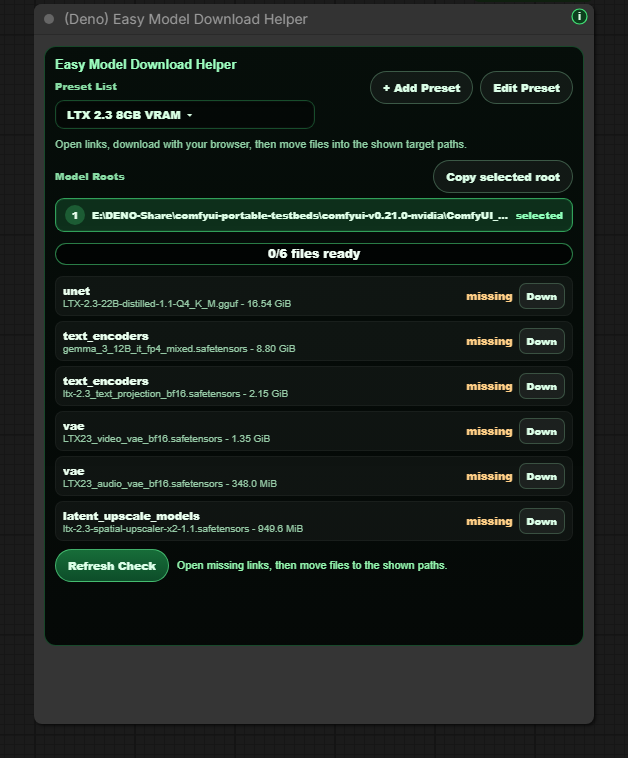
Main features:
- opens official model links in the browser instead of downloading files in Python
- shows detected ComfyUI model roots and lets users copy the selected root
- supports saved creator presets inside the workflow and restores them from browser storage after a page reload
- supports Hugging Face direct links and Civitai page/download links without Python-side network requests
- checks ComfyUI-registered model folders, including custom folder names from
extra_model_paths - checks each preset's exact target path inside those registered model folders without scanning unrelated nested project folders
- shows target ComfyUI model subfolders so viewers know exactly where files should go
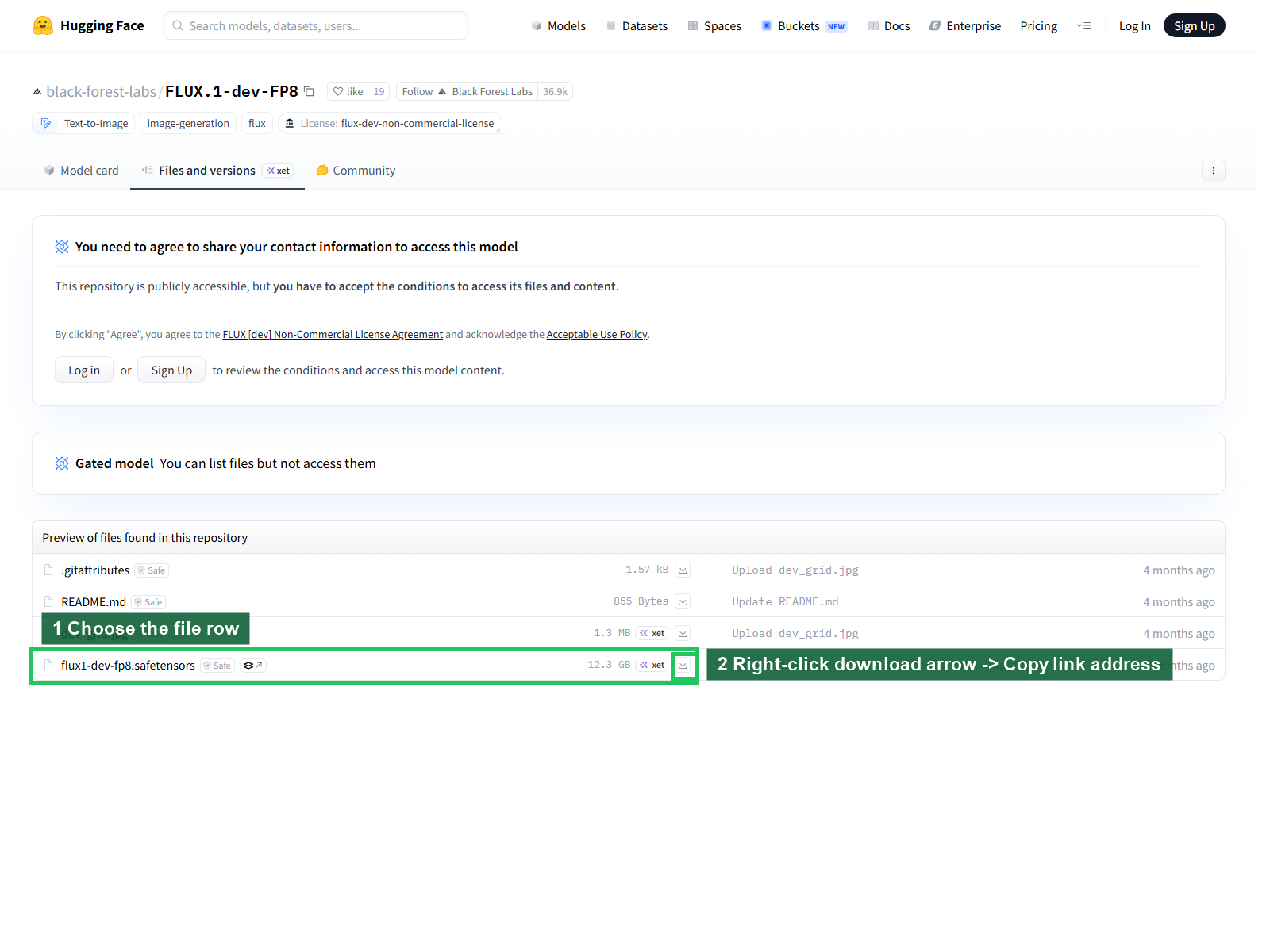
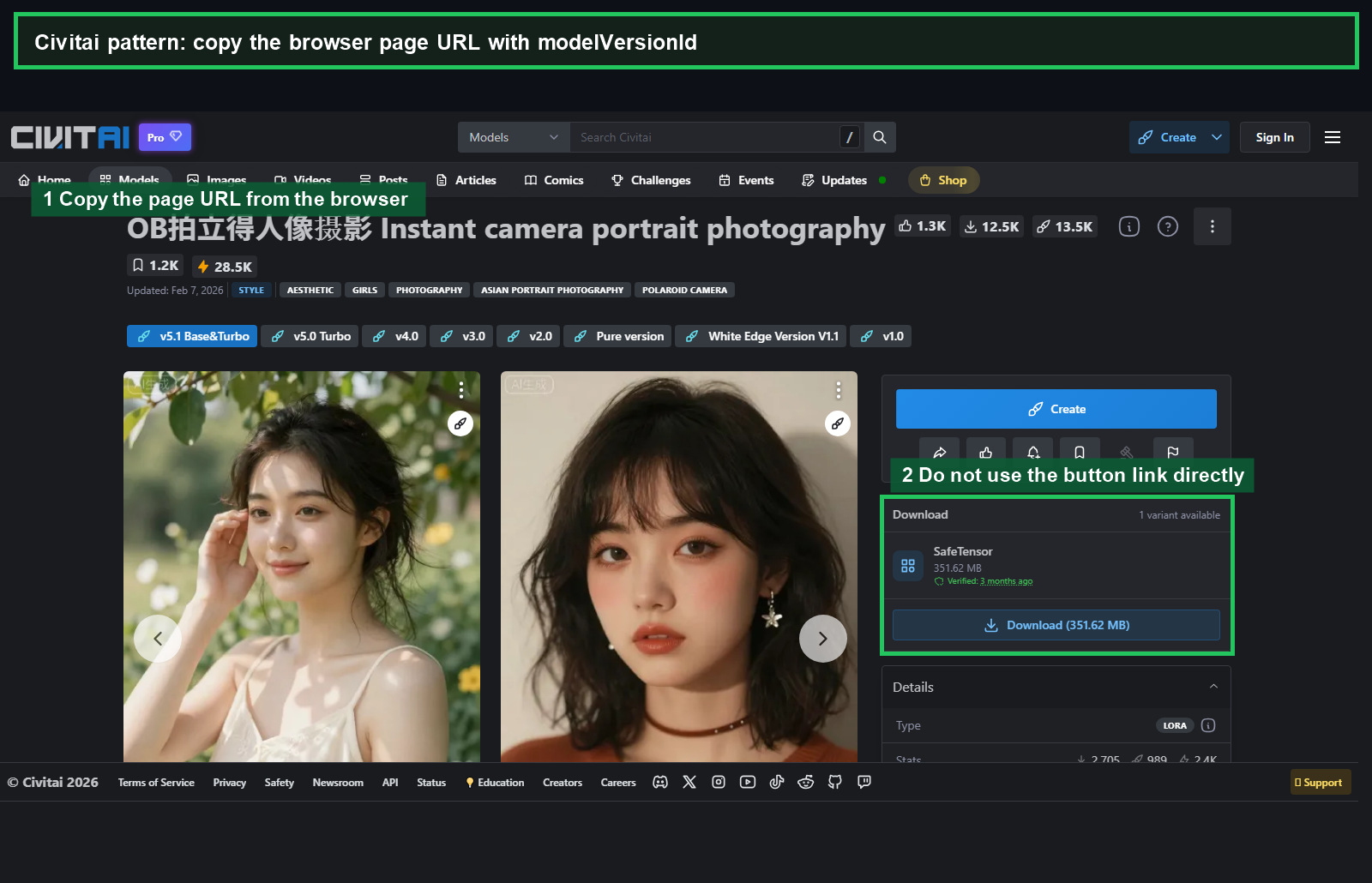
Creator preset link guide:
- Hugging Face: right-click the small download icon next to the target file, choose
Copy link address, then paste that direct file URL into the presetURLfield. - Civitai: copy the model page URL from the browser address bar, paste it into the preset
URLfield, then press theCivitaibutton in the editor to convert it to a direct browser download link. If the filename is not visible in the URL, enter the downloaded filename manually. - For Civitai pages, do not copy the blue
Downloadbutton link unless you intentionally want to provide a direct API download URL. File nameis used only for the target-path check. It should match the downloaded file on disk, especially for Civitai/API links.
(Deno) LTX Multi LoRA Loader
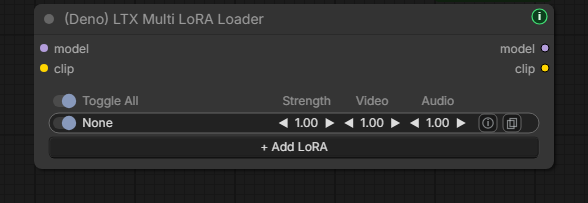
Power-LoRA-style multi LoRA loader for LTX workflows.
Main features:
- add multiple LoRAs in one compact node
- per-slot enable toggle
- per-slot
strength,video, andaudiostrength controls - per-slot trigger word and LoRA note editor
- copy saved trigger words from the LoRA row
- outputs patched
modelandclip - designed to stay close to the familiar Power LoRA Loader workflow while adding LTX-friendly A/V controls and lightweight LoRA reference notes
(Deno) LTX Prompt Guide
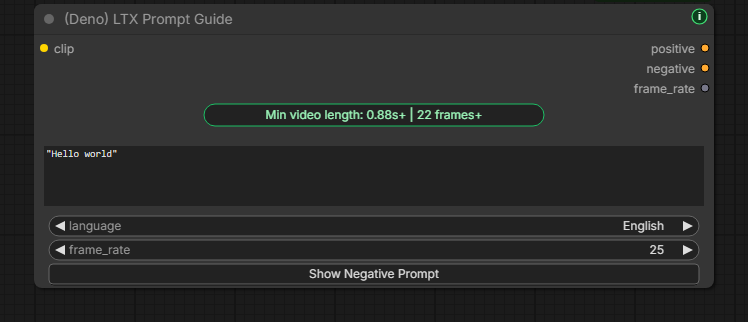
Prompt helper that combines LTX prompt encoding, optional negative prompt handling, built-in LTX conditioning, and dialogue-length planning.
Main features:
- positive prompt text encoding
- optional collapsible negative prompt
- built-in LTX conditioning with
frame_rate - estimates minimum video length from quoted dialogue
- supports Auto, Korean, English, Japanese, and Chinese dialogue estimates
- outputs:
positive,negative,frame_rate
(Deno) Bernini Prompt Guide
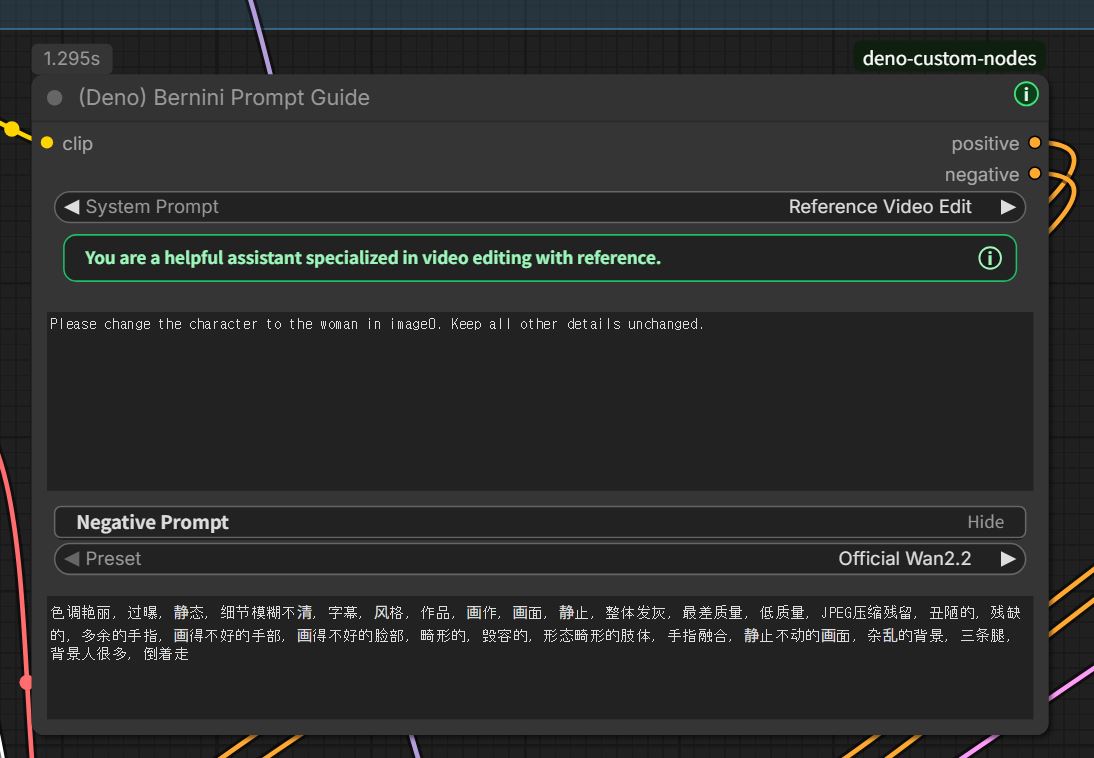
KJ-style Bernini prompt helper that combines positive and negative prompt encoding into one beginner-friendly node.
Main features:
System Promptselector with readable modes such asText to Video,Image to Video, andReference Video Edit- shows the active system prompt prefix directly on the top of the node
- writes prompts in instruction style, for example
Replace the jacket with the shirt from image0. Keep the camera motion, background, lighting, and shadows unchanged. - reference modes automatically add a short
image0,image1,image2naming hint internally - collapsible negative prompt section
- negative presets fill the visible negative prompt box; edit that box directly to change the final encoded negative prompt
- outputs:
positive,negative
Note: this node prepares text conditioning only. Bernini visual conditioning still requires a ComfyUI/KJ backend that supports Bernini context latents.
While that backend support is still a draft ComfyUI PR, use tools/DENO_Bernini_Preview_Backend_Update.bat only on a copied/test portable ComfyUI folder.
(Deno) Local LLM Loader and (Deno) Local LLM Reviewer
Local LLM workflow helpers for calling models that are already running on your PC and using text reviews to control what gets saved.
Main features:
- call local Ollama or LM Studio models from ComfyUI
- local-only server safety: use
127.0.0.1orlocalhost - refresh provider-specific model lists from the node
- stop a running local LLM request before unloading the model
- connect prompt batches through one node run so the local model can stay loaded until the batch finishes
- optionally attach an IMAGE to a vision-capable local model call
- preview Thinking and Result text directly on the node
- use
(Deno) Local LLM Revieweras a gate before Save nodes - pass or block IMAGE and AUDIO outputs from a review text result
- approve the current reviewed result once, or rerun the path before the reviewer
Audio note: the Local LLM Loader does not send AUDIO into a local model. The Reviewer can gate AUDIO when another text-generation node, including ComfyUI audio-capable text generation, creates the review text.
Why This Exists
These nodes are built to reduce repeated setup friction in actual ComfyUI production work. The goal is not to chase huge feature lists. The goal is to make the workflows people repeat every day feel faster, cleaner, and easier to teach.
Search Tips
Useful search terms for GitHub, ComfyUI Manager, and this README:
deno custom nodes(deno)comfyui custom nodesideogramideogram 4ideogram directorjson promptbboxbounding boxeslayout promptrtx superrtx video super resolutionrtx 2 pass2 pass upscalelow ram workflowmeta batchvideo super resolutionnvidia vfxnvvfximage comparevideo comparevideo previewvideo to gifgif webpwebp convertervideo converterltxltx 2.3ltx sequencerltx model loaderltx tiledltx tiled samplerltx spatial upscalerltx multi loraprompt guidesystem promptlocal llm loaderlocal llm promptlocal llm reviewerprompt onlyfinal promptai reviewermedia revieweraudio review gateollamalm studioberninibernini prompt guidebernini conditioningcomfyui berninikj berninireference video editwan-2.2wan2.2multi image loaderadvanced image sourceexternal folderresizeimage resizelora loaderggufvisual foldfold selected nodesworkflow toolsfloating toolsfree vramcomfyui stablestable update check
Install
Clone inside your custom_nodes folder:
git clone https://github.com/Deno2026/comfyui-deno-custom-nodes.git
Then restart ComfyUI.
Links
- YouTube: https://www.youtube.com/@Denoise-AI
- GitHub: https://github.com/Deno2026/comfyui-deno-custom-nodes
- Registry: https://registry.comfy.org/publishers/deno2026/nodes/deno-custom-nodes
Run ComfyUI workflows without the setup
No installs, no CUDA version roulette, no GPU sitting idle on your bill. Bring a workflow and run it in the browser.