
ComfyUI Extension: Majoor Assets Manager
Run ComfyUI workflows without the setup
No installs, no CUDA version roulette, no GPU sitting idle on your bill. Bring a workflow and run it in the browser.
An advanced Assets manager for ComfyUI outputs with gallery, metadata inspection, ratings, and tags.
Looking for a different extension?
Custom Nodes (3)
README
Majoor Assets Manager for ComfyUI










A media library for ComfyUI outputs, with deep workflow inspection and reuse tools.
Majoor Assets Manager helps you browse, inspect, and reuse ComfyUI assets without leaving the ComfyUI UI. It is built for large output folders, metadata-heavy workflows, and day-to-day review of generated images, videos, audio, and 3D assets.
Samples
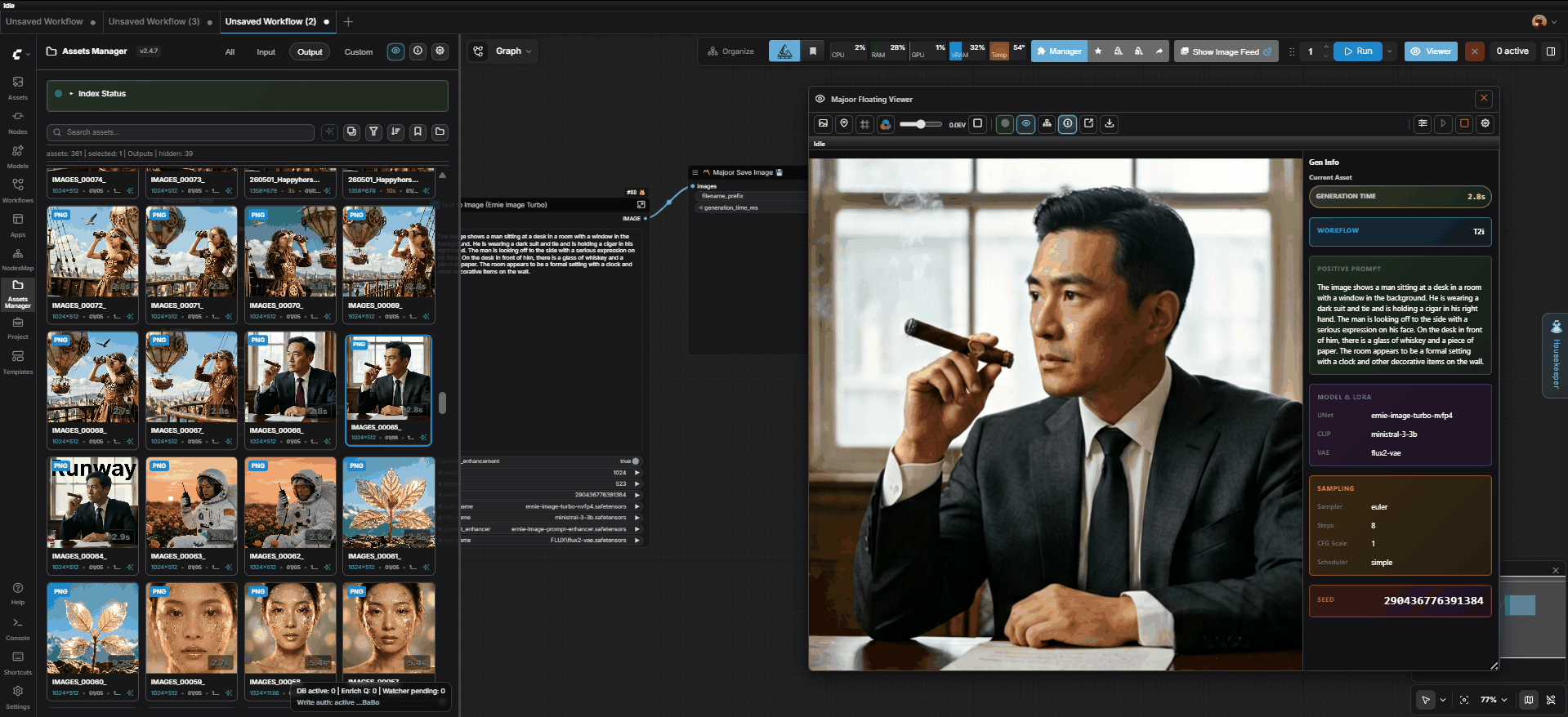
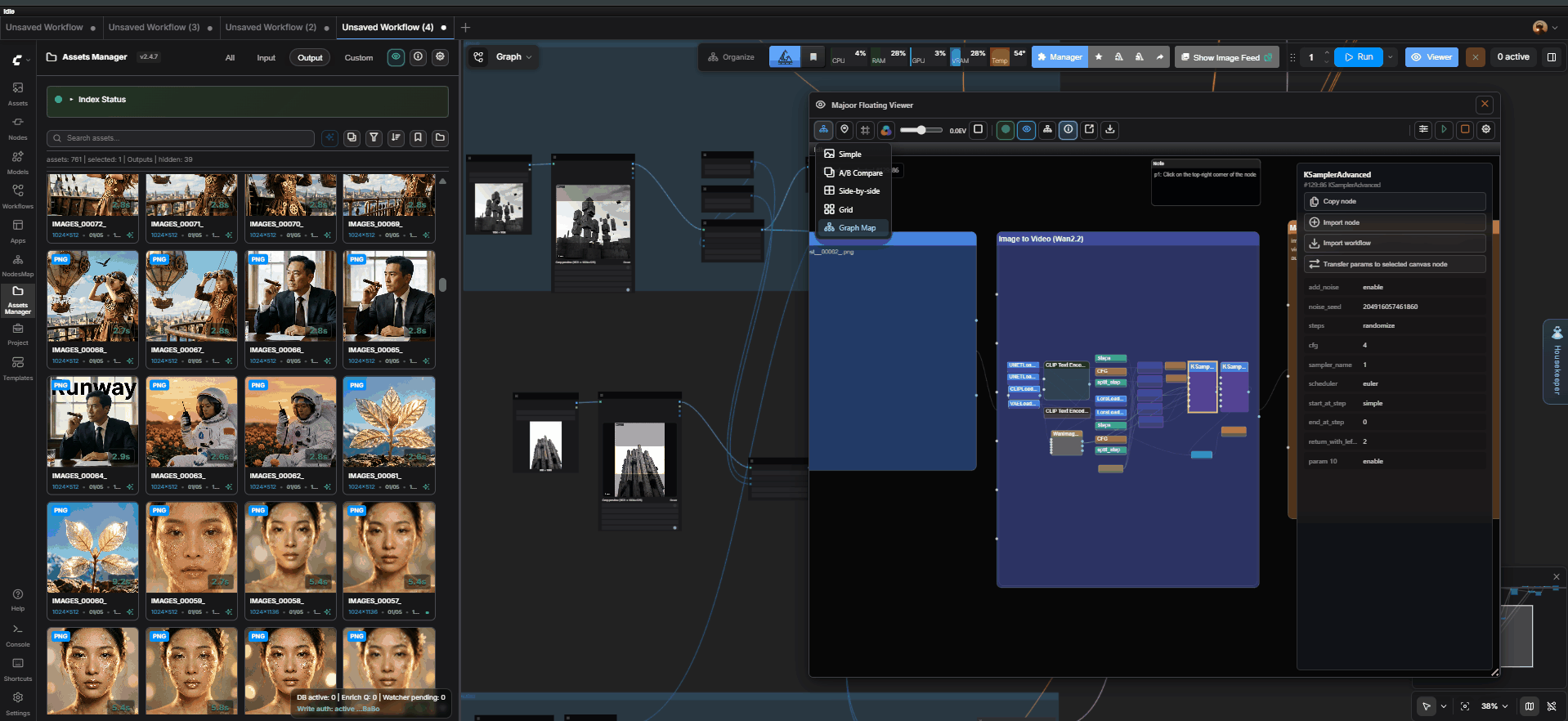
Quick Start: 5 Things You Can Do
- Browse your outputs: open the Assets Manager sidebar tab and choose Outputs, Inputs, Custom, or Collections.
- Find assets fast: search by filename, prompt, metadata, type, rating, workflow, date, size, or resolution.
- Inspect generation details: double-click an asset to view media, prompts, workflow metadata, and generation info.
- Compare and review: open the Majoor Floating Viewer for live generations, A/B compare, side-by-side review, pins, and Graph Map workflow inspection.
- Reuse assets in ComfyUI: drag assets to loader nodes or the canvas, use Load Asset, stage files to input, export clean files, or download selected files as a ZIP.
Useful first links:
- User guide:
user_guide.html - Documentation index:
docs/DOCUMENTATION_INDEX.md - Workflow tab guide:
docs/WORKFLOWS.md - MFV guide:
docs/MFV_GUIDE.md - Graph Map guide:
docs/GRAPH_MAP.md - Changelog:
CHANGELOG.md
Table of Contents
- Browse, Inspect, Reuse
- Latest Release
- Installation
- Basic Usage
- Majoor Floating Viewer (MFV)
- Graph Map
- Workflow Tab
- Custom Nodes
- Hotkeys & Shortcuts
- Advanced Features
- Troubleshooting
- Development & Testing
- Support
Browse, Inspect, Reuse
Browse
Use Assets Manager as a fast library for ComfyUI media:
- virtual grid browsing for large output folders
- Outputs, Inputs, Custom roots, and Collections scopes
- full-text search and structured filters
- ratings, tags, collections, duplicate awareness, and generation stacks
- right-click actions for rename, delete, open folder, copy path, download, and ZIP export
Inspect
Open assets when you need to understand how they were made:
- image, video, audio, and 3D preview surfaces
- prompts, workflow metadata, generation info, and timing details
- Majoor Floating Viewer for live review, A/B comparison, pins, and streams
- Graph Map for readable workflow navigation and node detail inspection
Reuse
Move useful assets and workflow context back into ComfyUI:
- drag assets to compatible loader nodes or the canvas
- use Load Asset to create loader nodes from selected media
- stage files into the ComfyUI input directory
- save, import, categorize, thumbnail, and reload workflow JSON files from the Workflow tab
- import or inspect embedded workflows without losing the current review flow
- export originals, clean metadata-stripped files, or selected files as a ZIP
Latest Release
v2.5.0 Highlights
- Experimental JPEG XL support: Optionally index, preview, view, and drag
.jxlimages. - Native ComfyUI subgraphs: Graph Map recursively expands nested subgraphs, including shared root-level definitions.
- Richer technical metadata: Inspect bit depth, pixel format, encoder, and color-space information.
- Runtime metadata ingestion: Preserve prompt, workflow, GenInfo, job, and source-node context after execution.
- Viewer and source-file actions: Use additional playback speeds and open generation source files in the viewer, Floating Viewer, folder, or asset loader.
- Find Similar menu: Find similar or duplicate assets and outputs from the same save node or workflow.
- Output fidelity: Majoor Save images include an sRGB ICC profile and MP4 outputs are explicitly tagged as BT.709.
- Stability fixes: Improved tags shortcuts, playback state, Floating Viewer controls, source-file loading, popover dismissal, and subgraph parsing.
See CHANGELOG.md for the complete release notes.
Installation
Method A: ComfyUI Manager (Recommended)
- Open ComfyUI Manager in your browser
- Search for "Majoor Assets Manager"
- Click Install, then restart ComfyUI completely
- The extension appears in the sidebar as a folder icon
Method B: Manual Installation
# Navigate to ComfyUI custom_nodes directory
cd ComfyUI/custom_nodes

# Clone the repository
git clone https://github.com/MajoorWaldi/ComfyUI-Majoor-AssetsManager ComfyUI-Majoor-AssetsManager

# Install Python dependencies
cd ComfyUI-Majoor-AssetsManager
pip install -r requirements.txt

# Optional: install AI/vector features
# pip install -r requirements.txt -r requirements-vector.txt

# Optional: install contributor tooling
# pip install -r requirements-dev.txt

# Restart ComfyUI
Dependency ownership is documented in docs/DEPENDENCY_POLICY.md. requirements.txt is the primary source of truth, requirements-vector.txt layers optional AI/vector dependencies on top, and requirements-dev.txt is reserved for contributor tooling.
Optional Dependencies (Highly Recommended)
For full metadata extraction and media probing:
Windows
# Using Scoop
scoop install ffmpeg exiftool

# OR using Chocolatey
choco install -y ffmpeg exiftool

# OR using WinGet
winget install -e --id Gyan.FFmpeg
winget install -e --id OliverBetz.ExifTool
macOS
brew install ffmpeg exiftool
Linux
# Ubuntu/Debian
sudo apt update
sudo apt install -y ffmpeg libimage-exiftool-perl

# Fedora/RHEL
sudo dnf install -y ffmpeg perl-Image-ExifTool

# Arch Linux
sudo pacman -S ffmpeg exiftool
Verify installation:
exiftool -ver
ffprobe -version
See docs/INSTALLATION.md for detailed instructions.
Experimental JPEG XL Support
JPEG XL indexing is disabled by default because decoder availability varies between Pillow and FFmpeg builds.
- Open Settings → Majoor Assets Manager → Scanning.
- Enable JPEG XL (JXL) support (Experimental).
- Run a new scan to index existing
.jxlfiles.
Majoor can then index, preview, view, and drag JPEG XL assets. Thumbnail generation still requires JPEG XL support in the installed Pillow or FFmpeg build. The equivalent environment variable is MAJOOR_ENABLE_JXL=1.
ComfyUI Desktop Popup Workaround
If you use the official ComfyUI Desktop / Electron build and want the Majoor Floating Viewer to open in a real detachable window that can be moved to another monitor, the Desktop host must allow window.open("about:blank") popups.
The Majoor plugin already tries to open a real popup first on Desktop. Some Desktop builds still block that popup in the Electron host and redirect it to the OS instead. If that happens, use the advanced workaround in docs/DESKTOP_POPUP_WORKAROUND.md. Browser-based ComfyUI does not require this Electron host patch.
Custom Nodes
Majoor Assets Manager ships three ComfyUI nodes. Majoor Save Image and Majoor Save Video persist generation timing metadata directly inside saved files, allowing the asset manager to index generation_time_ms alongside prompt/workflow data. Majoor GenInfo Override supplies explicit generation metadata to either save node.
Full reference: docs/CUSTOM_NODES.md
The video node requires PyAV. It is included in the runtime dependency contract (requirements.txt and pyproject.toml) so the documented manual install commands install it automatically.
Majoor GenInfo Override 🧩
Builds an explicit MAJOOR_GENINFO payload for Majoor Save Image or Majoor Save Video. Use it when automatic graph tracing cannot reliably identify prompts, seeds, sampler settings, models, LoRAs, or custom workflow notes.
Connect its geninfo_override output to the matching input on a Majoor Save node. The optional workflow_context input can be connected to a late workflow node so the override executes with complete graph context.
Majoor Save Image 💾
Drop-in replacement for the built-in SaveImage node. Saves PNG files with generation_time_ms embedded in the PNG text chunks.
| Input | Type | Required | Default | Description |
|-------|------|----------|---------|-------------|
| images | IMAGE | ✅ | — | The image batch to save |
| filename_prefix | STRING | ✅ | Majoor | Filename prefix (supports ComfyUI %date% placeholders) |
| generation_time_ms | INT | ❌ | -1 (auto) | Generation time in ms. -1 = auto-detect from prompt lifecycle |
Metadata written to each PNG:
prompt— full ComfyUI prompt graph (JSON)workflow— full workflow (JSON)generation_time_ms— elapsed time since prompt start (ms)CreationTime— ISO timestamp
Majoor Save Video 🎬
Saves a VIDEO input or a batch of IMAGE frames as a video file. Supports MP4 (h264 via PyAV), GIF, and WebP.
| Input | Type | Required | Default | Description |
|-------|------|----------|---------|-------------|
| filename_prefix | STRING | ✅ | MajoorVideo | Filename prefix |
| format | COMBO | ✅ | mp4 (h264) | Output format: mp4 (h264), gif, webp |
| images | IMAGE | ❌ | — | Batch of frames (alternative to video) |
| video | VIDEO | ❌ | — | A VIDEO input from LoadVideo/CreateVideo |
| frame_rate | FLOAT | ❌ | 24.0 | FPS (ignored when VIDEO input carries its own rate) |
| loop_count | INT | ❌ | 0 | Loop count for GIF/WebP (0 = infinite) |
| generation_time_ms | INT | ❌ | -1 (auto) | Generation time in ms. -1 = auto-detect |
| audio | AUDIO | ❌ | — | Audio track to mux into MP4 |
| crf | INT | ❌ | 19 | Constant Rate Factor (0-63, lower = higher quality) |
| save_first_frame | BOOLEAN | ❌ | true | Save a PNG sidecar of the first frame with full metadata |
MP4 container metadata:
prompt,workflow,generation_time_ms,CreationTime— written via PyAV withmovflags=use_metadata_tags
Notes:
- At least one of
imagesorvideomust be connected - When a
videoinput is connected, its native frame rate and audio are used automatically - GIF/WebP outputs rely on the PNG sidecar for metadata persistence
Auto-Detection of generation_time_ms
When generation_time_ms is left at -1 (default), the node reads the prompt start time from Majoor's runtime_activity module, which hooks into the ComfyUI prompt lifecycle. This gives an accurate wall-clock measurement of generation time without any manual wiring.
If the Majoor nodes are not used, the asset manager falls back to its standard metadata extraction (EXIF dates, prompt graph analysis, etc.).
Basic Usage
First Steps
- Open Assets Manager: Click the folder icon in ComfyUI sidebar
- Choose Scope: Select Outputs, Inputs, Custom, or Collections
- Browse Assets: Scroll through the grid view with virtual scrolling
- Search: Type in the search bar for full-text search
- Filter: Use dropdowns for kind, rating, workflow, date filters
Asset Operations (Right-Click Menu)
- Open in Viewer: Double-click or right-click → Open in Viewer
- Rate: Assign 0-5 stars
- Edit Tags: Add/remove custom tags
- Add to Collection: Save to existing or new collection
- Rename: Change filename
- Delete: Remove asset (with confirmation)
- Open in Folder: Show in file explorer
- Copy Path: Copy full file path to clipboard
- Stage to Input: Copy to ComfyUI input directory
Collections
- Select assets (Ctrl/Cmd+click for multiple)
- Right-click → Add to Collection
- Create new or add to existing collection
- Access via Collections scope
Majoor Floating Viewer (MFV)
MFV now has a dedicated illustrated guide focused on the real workflow inside the floating viewer: compare modes, A/B/C/D pins, Live Stream, Node Stream, KSampler Preview, Node Parameters, Run / Stop, Pop-out, and the Graph Map companion view.
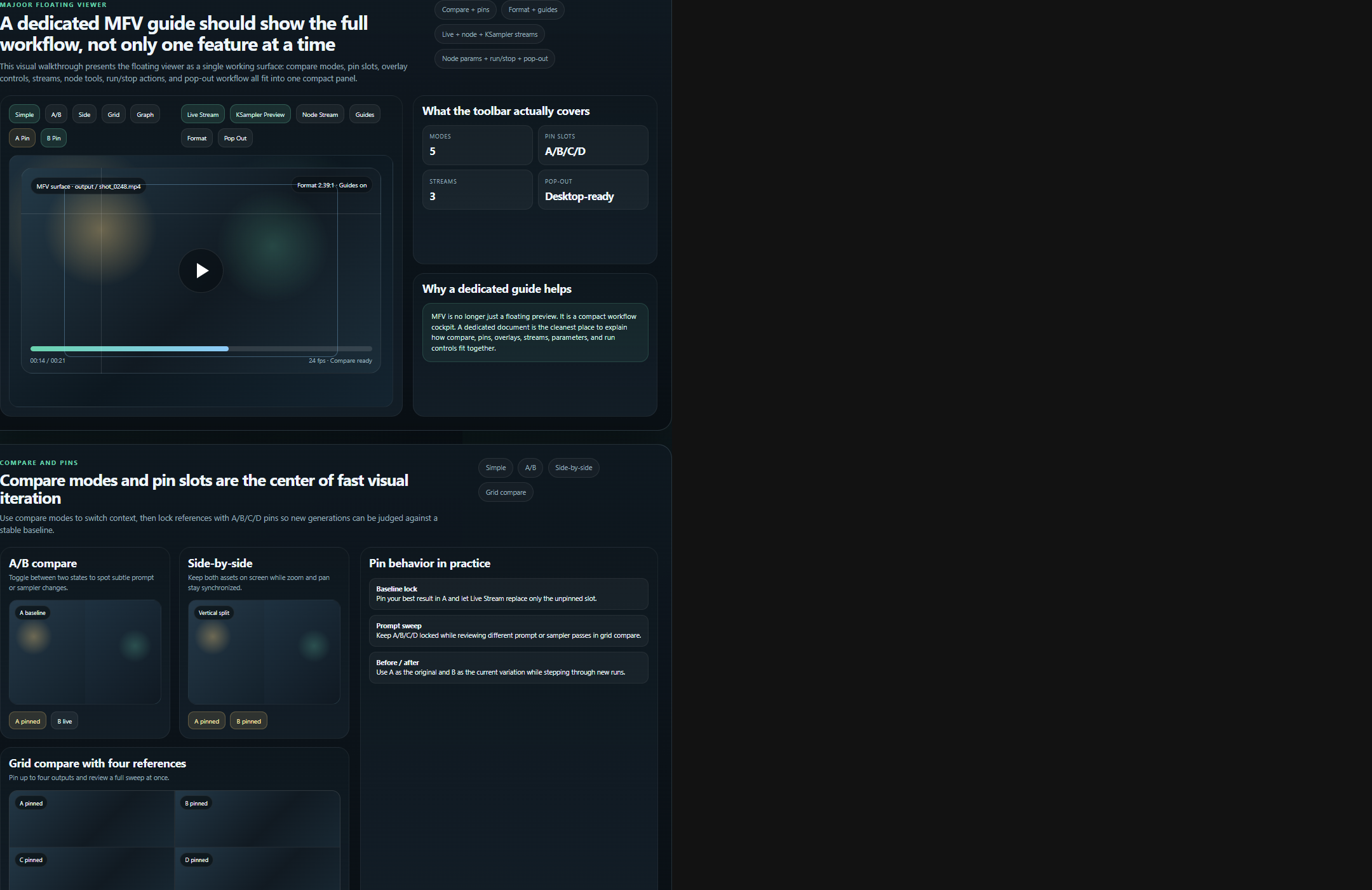
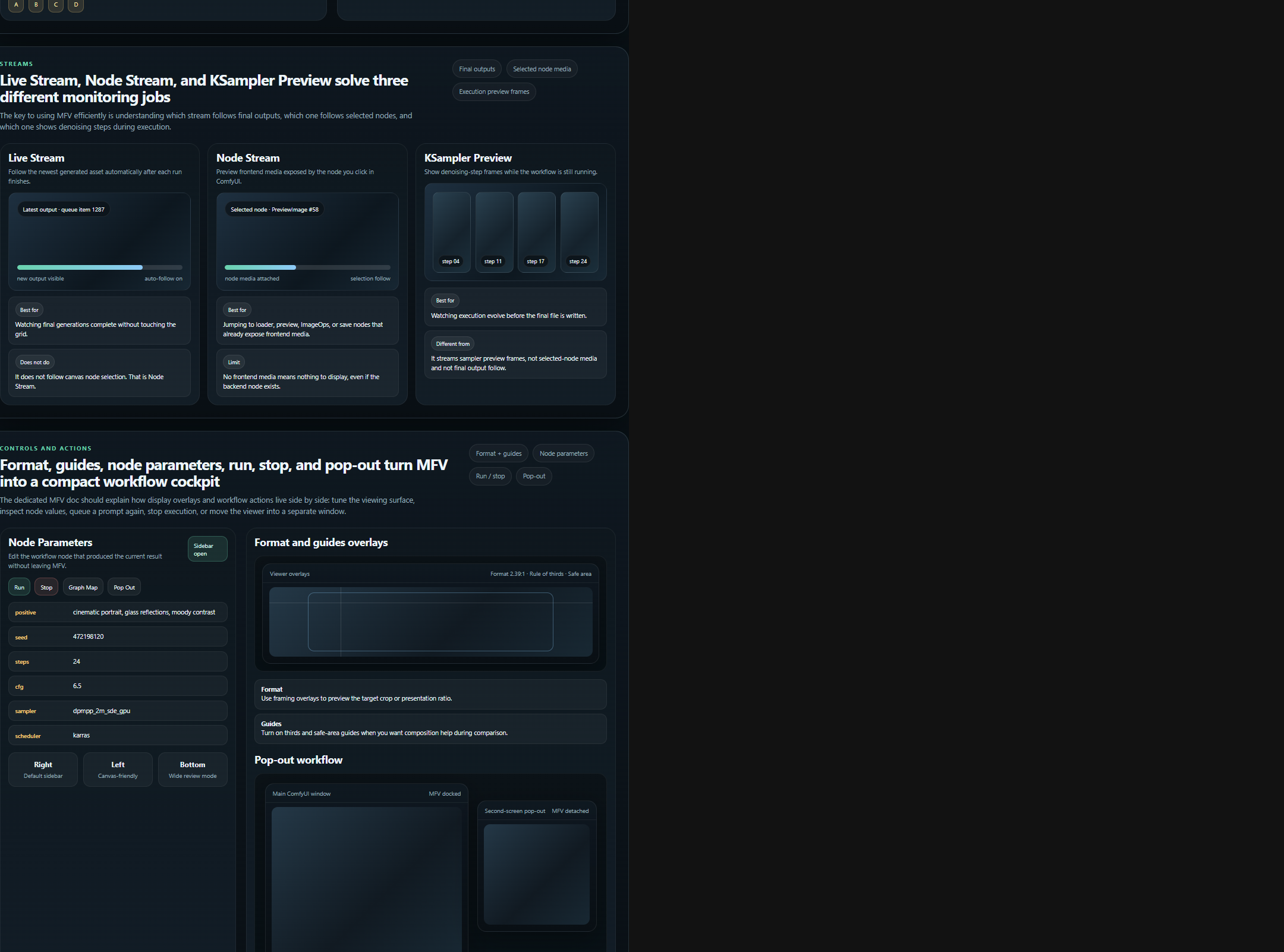
Opening the Floating Viewer
- Click the Floating Viewer button in the Assets Manager toolbar
- Or use the viewer from the ComfyUI canvas context menu
Live Stream Mode
- Automatically tracks new generations
- Follows the latest completed output file instead of the currently selected node
- No manual refresh needed
Compare Modes
- Simple: Single asset view
- A/B Compare: Fast two-slot comparison
- Side-by-Side: View both assets simultaneously
- Grid: Review up to four pinned or selected references together
Node Stream
- Enable Node Stream, then select a compatible node in ComfyUI
- MFV shows the selected node's media when that node exposes a frontend preview
- Useful for preview nodes, loader/save nodes, and compatible live-preview surfaces
Disable MFV Auto-Open
If the Floating Viewer opens automatically during renders or after clicking nodes, turn off the stream features that trigger it:
- Open Settings → Majoor Assets Manager → Viewer.
- Disable Majoor: MFV Live Stream Enabled by Default to stop MFV from auto-following final render outputs when a generation finishes.
- Disable Majoor: MFV KSampler Preview Enabled by Default to stop MFV from auto-opening for sampler/denoising preview frames during a render.
- In the Floating Viewer toolbar, turn Node Stream off if node clicks are making MFV follow selected-node previews.
You can still open MFV manually with the toolbar button or the V shortcut after disabling these defaults.
Why MFV And Graph Map Work Together
- Use MFV for live review, compare, pins, streams, and quick reruns.
- Open Graph Map when you need workflow context for the current asset.
- Move from visual review to readable node and subgraph inspection without leaving the viewer workflow.
See docs/MFV_GUIDE.md for the dedicated MFV guide, docs/GRAPH_MAP.md for the full workflow-map walkthrough, and docs/VIEWER_FEATURE_TUTORIAL.md for the broader viewer documentation.
Graph Map
Graph Map is the workflow navigation view inside the Floating Viewer. It keeps the asset preview, the saved workflow, and the selected node details together so you can understand where a result came from without leaving the viewer.
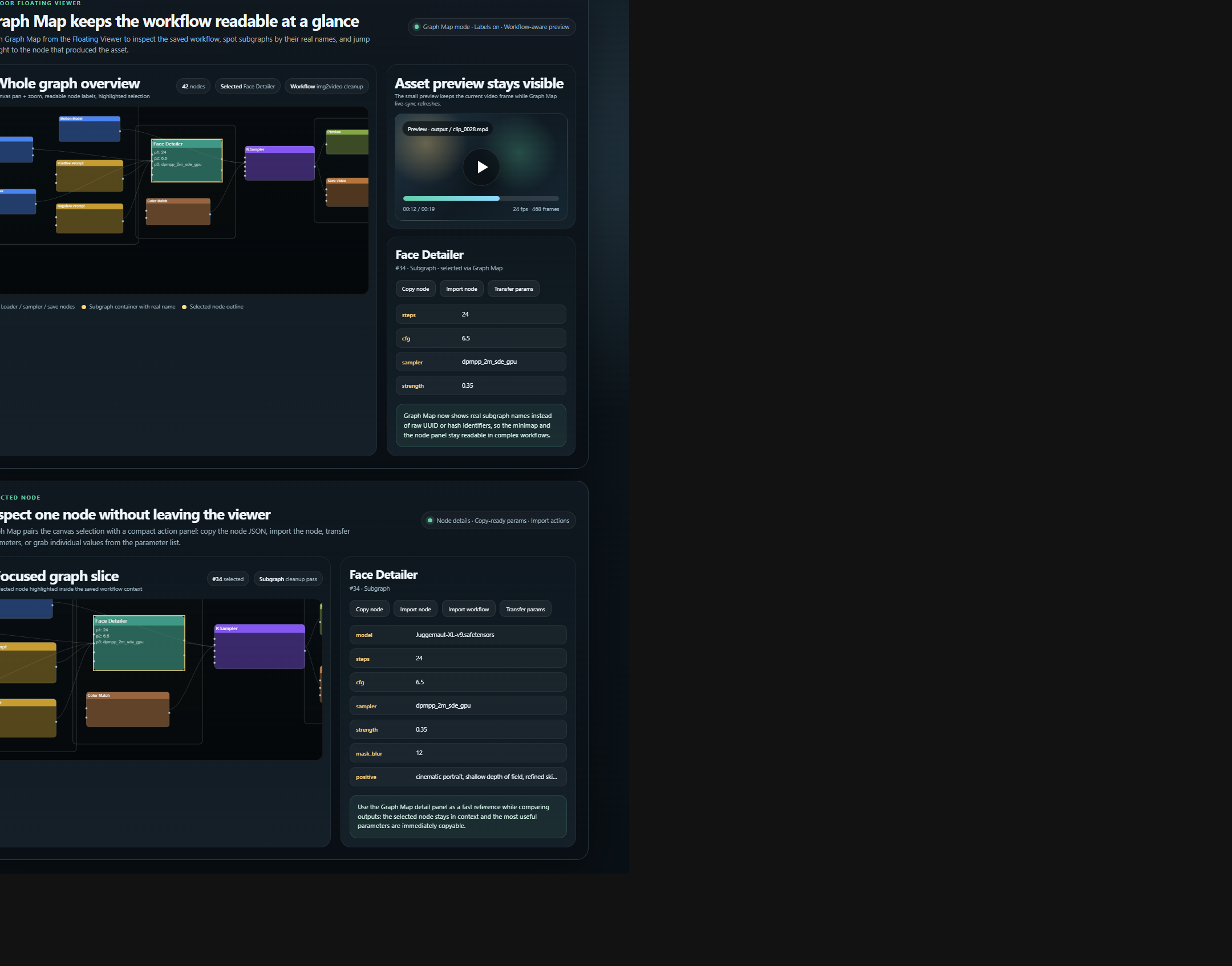
- Readable workflow view: node labels stay visible and named subgraphs show their real names instead of raw UUID/hash identifiers.
- Native nested subgraphs: recursively expands ComfyUI subgraphs and resolves definitions shared by the root workflow.
- Direct node inspection: click a node to open copyable parameters and actions such as copy node, import node, import workflow, or transfer params.
- Viewer-friendly preview: the small media preview stays in place while Graph Map refreshes, which is especially useful for video assets.
For the full walkthrough and the second screenshot focused on the node detail panel, see docs/GRAPH_MAP.md.
Controls
- Zoom: Mouse wheel
- Pan: Click and drag
- Move Panel: Drag from panel header
- Resize: Drag panel edges
- Close: ESC or close button
- Focused Player Shortcuts: Click once on the inline player, then use Space to play/pause and Left/Right to step frame by frame
Workflow Tab
The Workflow tab is a reusable workflow library for ComfyUI .json files. It can save the current canvas, import workflow JSON files, load saved workflows back into ComfyUI, inspect them in Graph Map, and organize them with categories, tags, thumbnails, notes, favorites, usage metadata, and detected task/model/provider fields.
See docs/WORKFLOWS.md for the full Workflow tab guide.
Hotkeys & Shortcuts
Global / Panel
| Shortcut | Action | |----------|--------| | Ctrl+S / Cmd+S | Trigger index scan | | Ctrl+F / Ctrl+K | Focus search input | | Ctrl+H | Clear search input | | D | Toggle sidebar (details) | | V | Toggle Floating Viewer |
Grid View
| Shortcut | Action | |----------|--------| | Arrow Keys | Navigate selection | | Enter / Space | Open Viewer | | V | Open selected asset in Floating Viewer | | S | Download selected asset | | Ctrl+A | Select all | | Ctrl+D | Deselect all | | Ctrl+Click | Toggle selection | | Shift+Click | Range selection | | 0-5 | Set rating (0-5 stars) | | T | Edit tags | | B | Add to collection | | F2 | Rename file | | Delete | Delete file |
Viewer
| Shortcut | Action | |----------|--------| | Esc | Close viewer | | F | Toggle fullscreen | | D | Toggle info panel | | Space | Play/pause video | | S | Download original from context menu | | Left/Right | Previous/next asset, or step frame when the focused player bar is active | | Mouse Wheel | Zoom in/out | | I | Toggle pixel probe | | C | Copy probed color | | L | Toggle loupe | | Z | Toggle zebra patterns | | G | Cycle grid overlays | | Alt+1 | Toggle 1:1 pixel view |
Drag & Drop
| Gesture | Action | |---------|--------| | S+Drag to OS | Export clean copy/ZIP without ComfyUI metadata | | L+Drop on canvas | Load selected asset(s) by creating matching media loader node(s) |
MFV
| Shortcut | Action | |----------|--------| | Esc | Close Floating Viewer | | V | Toggle Floating Viewer | | C | Cycle quick compare modes: Simple, A/B, Side-by-Side | | K | Toggle KSampler Preview | | L | Toggle Live Stream | | N | Toggle Node Stream | | Space | Play/pause the focused inline player | | Left/Right | Step frame when the focused inline player is active |
See docs/HOTKEYS_SHORTCUTS.md and docs/SHORTCUTS.md for complete lists.
Advanced Features
The README focuses on the user workflow. Detailed reference material lives in the docs folder so new users do not have to read every subsystem before using the extension.
AI And Vector Search
Optional AI features add semantic search, visual similarity, auto-tags, captions, prompt alignment, and smart collection suggestions. They require additional model dependencies and a vector backfill step for best coverage.
Low-VRAM systems can disable semantic search, disable vector indexing during scans, keep vector concurrency at 1, and enable Unload AI models after use in Settings -> Search -> AI. The Memory purge action in Index Status releases Majoor's SigLIP/X-CLIP/Florence caches and asks ComfyUI to unload loaded models when the queue is idle.
Read: docs/AI_FEATURES.md
Privacy And Offline Use
AI inference is designed to run locally. Internet access is mainly needed for the first model download from HuggingFace, and cached models can be used offline afterward.
Read: docs/PRIVACY_OFFLINE.md
Configuration And Security
Most users can use the default local setup. Remote access, API tokens, safe-mode write controls, index directory overrides, and environment variables are documented separately.
Read:
API, Database, And Maintenance
Backend endpoint details, database recovery, index reset, and contributor architecture notes are available as advanced references.
Read:
Troubleshooting
Extension Not Appearing
- Verify installation in
custom_nodes/ComfyUI-Majoor-AssetsManager - Check ComfyUI console for import errors
- Ensure core dependencies are installed:
pip install -r requirements.txt - If you use AI/vector features, also install:
pip install -r requirements.txt -r requirements-vector.txt - Restart ComfyUI completely
Database Corruption
If the index database is corrupted:
Option 1: Use Delete DB Button (Recommended)
- Open Assets Manager → Index Status section
- Click Delete DB button
- Confirm the warning dialog
- Database rebuilds automatically
Option 2: Manual Recovery
- Stop ComfyUI completely
- Navigate to
<output>/_mjr_index/ - Delete
assets.sqlite,assets.sqlite-wal,assets.sqlite-shm - Restart ComfyUI
See docs/DB_MAINTENANCE.md for detailed recovery procedures.
External Tools Not Found
- Verify installation:
exiftool -verandffprobe -version - Check if tools are in system PATH
- Set environment variables for explicit paths
- Restart ComfyUI after installing tools
Slow Performance
- First scan of large directories takes time (incremental indexing helps)
- Reduce page size in settings for lower memory usage
- Exclude very large directories from custom roots
- Ensure SSD storage for better database performance
Search Not Working
- Trigger manual scan with Ctrl+S
- Verify the correct scope is selected
- Check if directory has been indexed (status indicator)
- Clear browser cache and reload
Drag & Drop Issues
- Verify browser supports HTML5 drag & drop
- Check file permissions for source files
- For multi-select ZIP, ensure sufficient disk space
- Try a different browser if issues persist
API / Remote Access
- Set
MAJOOR_API_TOKENfor secure remote access - Configure
MAJOOR_TRUSTED_PROXIESif behind reverse proxy - Check firewall settings for ComfyUI port
- Verify CORS settings if accessing from different origin
“Write access is blocked”
Majoor's write guard is separate from Windows, Linux, macOS, or NAS file permissions. A user can have full access to the files and still be blocked by Majoor when ComfyUI is opened through a LAN IP, reverse proxy, or tunnel. Majoor protects operations that modify data, including ratings, tags, rename, delete, index reset, and some file actions.
For the safest remote setup, open Settings → Majoor Assets Manager → Security and enable Recommended Remote LAN Setup. This creates or reuses an API token and authorizes the current browser. On a trusted private LAN using plain HTTP, Allow HTTP Token Transport may also be required.
The settings shown below enable the individual operations while keeping Safe Mode off and delete confirmation on. They do not by themselves authorize an anonymous LAN client: remote access still requires either Recommended Remote LAN Setup with a token, or Allow Remote Full Access on a fully trusted private LAN.
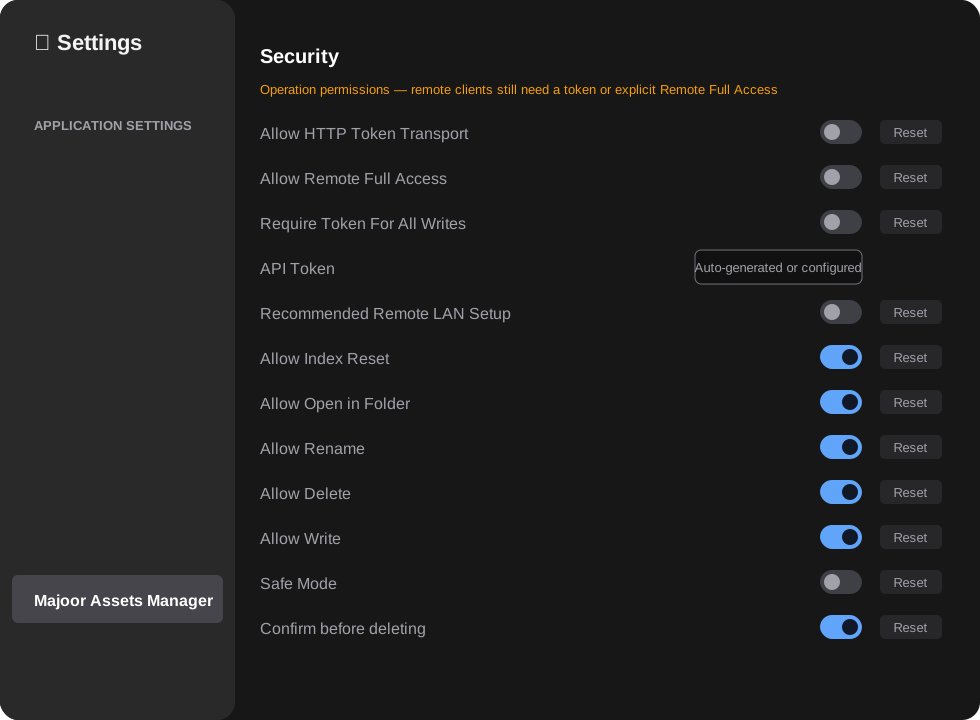
Do not enable Allow Remote Full Access when ComfyUI is exposed to the internet, an untrusted network, or an unprotected tunnel.
After changing the settings, refresh the ComfyUI page. Restart ComfyUI if environment variables override the UI values. See Remote Access Write Permissions for the complete decision guide.
Development & Testing
Dependency Setup
# Runtime-only install
pip install -r requirements.txt

# Runtime + optional AI/vector features
pip install -r requirements.txt -r requirements-vector.txt

# Contributor tooling (tests, lint, typing, security checks)
pip install -r requirements-dev.txt

# Frontend tooling
npm ci
Dependency roles and update rules are defined in docs/DEPENDENCY_POLICY.md.
Project Structure
ComfyUI-Majoor-AssetsManager/
├── __init__.py                 # Extension entry point
├── nodes.py                    # ComfyUI custom nodes
├── ui/                         # Frontend source (Vue 3, Pinia, TypeScript)
│   ├── app/                   # App initialization, settings
│   ├── components/            # UI components
│   ├── features/              # Feature modules
│   ├── stores/                # Pinia stores
│   ├── api/                   # API client
│   └── vue/                   # Vue components and source modules
├── dist/                       # Generated frontend bundle served by ComfyUI
├── vite.config.mjs            # Frontend build entry and bundle configuration
├── mjr_am_backend/            # Backend (Python)
│   ├── routes/                # API routes, route_catalog.py (declarative)
│   ├── routes/core/           # Shared HTTP helpers (security, path, JSON)
│   ├── routes/assets/         # Thin compat facades → features/assets/
│   ├── features/assets/       # Asset domain: 9 sub-services
│   ├── features/              # Other backend features
│   ├── adapters/db/           # SQLite: facade + split sub-modules
│   └── shared.py              # Shared backend helpers
├── mjr_am_shared/             # Shared code (frontend/backend)
├── tests/                     # Test suites
│   ├── core/                  # Core functionality tests
│   ├── metadata/              # Metadata extraction tests
│   ├── features/              # Feature tests
│   ├── database/              # Database tests
│   └── security/              # Security tests
├── docs/                      # Documentation
└── scripts/                   # Utility scripts
For detailed architecture and module responsibilities, see docs/ARCHITECTURE_MAP.md.
Running Tests
Backend Tests (pytest)
# All tests
python -m pytest tests/ -q

# Single test file
python -m pytest tests/core/test_routes.py -v

# Single test function
python -m pytest tests/core/test_routes.py::test_routes -v

# With coverage
pytest tests/ --cov=mjr_am_backend --cov-report=html
Frontend Tests (Vitest)
# Exact JavaScript test command used by CI
npm run test:js

# Exact frontend typecheck used by CI
npx tsc -p tsconfig.json --noEmit --pretty false

# Build and verify the generated dist bundle
npm run build

# Watch mode
npm run test:js:watch
Exact Backend CI Test
python -m pytest -q --timeout=300 --cov=mjr_am_backend --cov=mjr_am_shared --cov-branch --cov-fail-under=60 --cov-report=xml --cov-report=term-missing:skip-covered
Windows Batch Runners
# Full test suite
run_tests.bat

# With JUnit XML and HTML reports
tests/run_tests_all.bat
The Windows report runner generates tests/__reports__/index.html; the file is not present until that runner completes.
Code Quality
# Install local git hooks once
python scripts/install_local_hooks.py

# Canonical repo quality gate
python scripts/run_quality_gate.py

# Fast Python-only gate
python scripts/run_quality_gate.py --python-only --skip-tests

# Fast local pre-push equivalent on changed files
python scripts/run_changed_quality_gate.py

# Individual checks
mypy --config-file mypy.ini
python -m ruff check mjr_am_backend mjr_am_shared tests scripts __init__.py
bandit -r mjr_am_backend -ll -ii -x tests
pip-audit -r requirements.txt
python scripts/check_cc_changed.py

# Optional auto-fix
python -m ruff check --fix mjr_am_backend mjr_am_shared tests scripts __init__.py
Contributing
- Fork the repository
- Create a feature branch
- Install contributor dependencies:
pip install -r requirements-dev.txt - Install local hooks:
python scripts/install_local_hooks.py - Make your changes
- Run tests:
run_tests.bat - Submit a pull request
See docs/TESTING.md, tests/README.md, and docs/DEPENDENCY_POLICY.md for detailed contributor guidance.
Data Locations
| Data Type | Location |
|-----------|----------|
| Index Database | <output>/_mjr_index/assets.sqlite |
| Custom Roots Config | <output>/_mjr_index/custom_roots.json |
| Collections | <output>/_mjr_index/collections/*.json |
| Temp Batch ZIPs | <output>/_mjr_batch_zips/ |
| Browser Settings | localStorage.mjrSettings |
Compatibility
- ComfyUI: ≥ 0.13.0 (recommended baseline)
- Python: 3.10, 3.11, 3.12, 3.13
- Supported Operating Systems:
- Windows 10/11
- macOS 10.15+
- Linux (Ubuntu 22.04+, Fedora, Debian)
- Browsers: Modern browsers with ES2020+ support
The automated CI matrix currently validates Python 3.10-3.13 and the frontend on Ubuntu. Windows and macOS support is maintained through portable code paths and contributor/user testing rather than dedicated hosted CI jobs.
Support
Documentation
- 📚 Documentation Index
- 🔐 Privacy / Offline Guide
- 📖 User Guide (HTML)
- 🔧 API Reference
- 🛠️ Installation Guide
- ⚙️ Settings & Configuration
- 🔒 Security Model
- 🗄️ Database Maintenance
- 🎯 Viewer Tutorial
- 🏷️ Ratings & Tags
- 🔍 Search & Filtering
- 🎹 Hotkeys & Shortcuts
- 📦 Drag & Drop
- 🧪 Testing Guide
Community
- 🐛 Report Issues
- 💡 Use GitHub Issues for bug reports, support requests, and security/privacy questions
- ☕ Support the Developer
Notes
- GitHub Discussions may not be enabled or available at all times for this repository.
- If the Discussions link is unavailable, please open an Issue instead.
Troubleshooting Resources
- Check ComfyUI console for error messages
- Review relevant documentation sections above
- Search existing GitHub issues
- Verify external tools installation
- Try resetting/deleting the database
License
Copyright (c) 2026 Ewald ALOEBOETOE (MajoorWaldi)
Licensed under the GNU General Public License v3.0 (LICENSE).
Optional attribution request: See NOTICE file for details.
Acknowledgments
- ComfyUI team for the amazing node-based UI
- ComfyUI Manager for easy extension distribution
- ExifTool and FFprobe developers for metadata extraction
- Vue.js team for the frontend framework
- All contributors and users of this extension
Last updated: July 9, 2026 Version: 2.5.0
Run ComfyUI workflows without the setup
No installs, no CUDA version roulette, no GPU sitting idle on your bill. Bring a workflow and run it in the browser.