
ComfyUI Extension: ComfyUI-ThinkingLLM
Run ComfyUI workflows without the setup
No installs, no CUDA version roulette, no GPU sitting idle on your bill. Bring a workflow and run it in the browser.
A multimodal ComfyUI AI node with Qwen3.5, Qwen3-VL, Qwen2.5-VL, Qwen3, and Gemma 4 integrations. Features live thinking in the terminal to see what the LLM is doing in real time.
Looking for a different extension?
Custom Nodes (10)
README
ComfyUI-ThinkingLLM
ThinkingLLM is a local-LLM custom-node pack for ComfyUI that wraps Qwen3.5, Qwen3, Qwen-VL, Gemma 4, and Whisper ASR behind a cleaner node interface with thinking-mode control, audio/vision workflows, live token streaming, and a raw trace output for debugging.
📺 Watch the demo for a better viewing experience.
GPL-3.0 fork of Deaquay/ComfyUI-Qwen3.5-Uncensored, itself derived from huchukato/ComfyUI-QwenVL-Mod and 1038lab/ComfyUI-QwenVL. See LICENSE.
.gif)
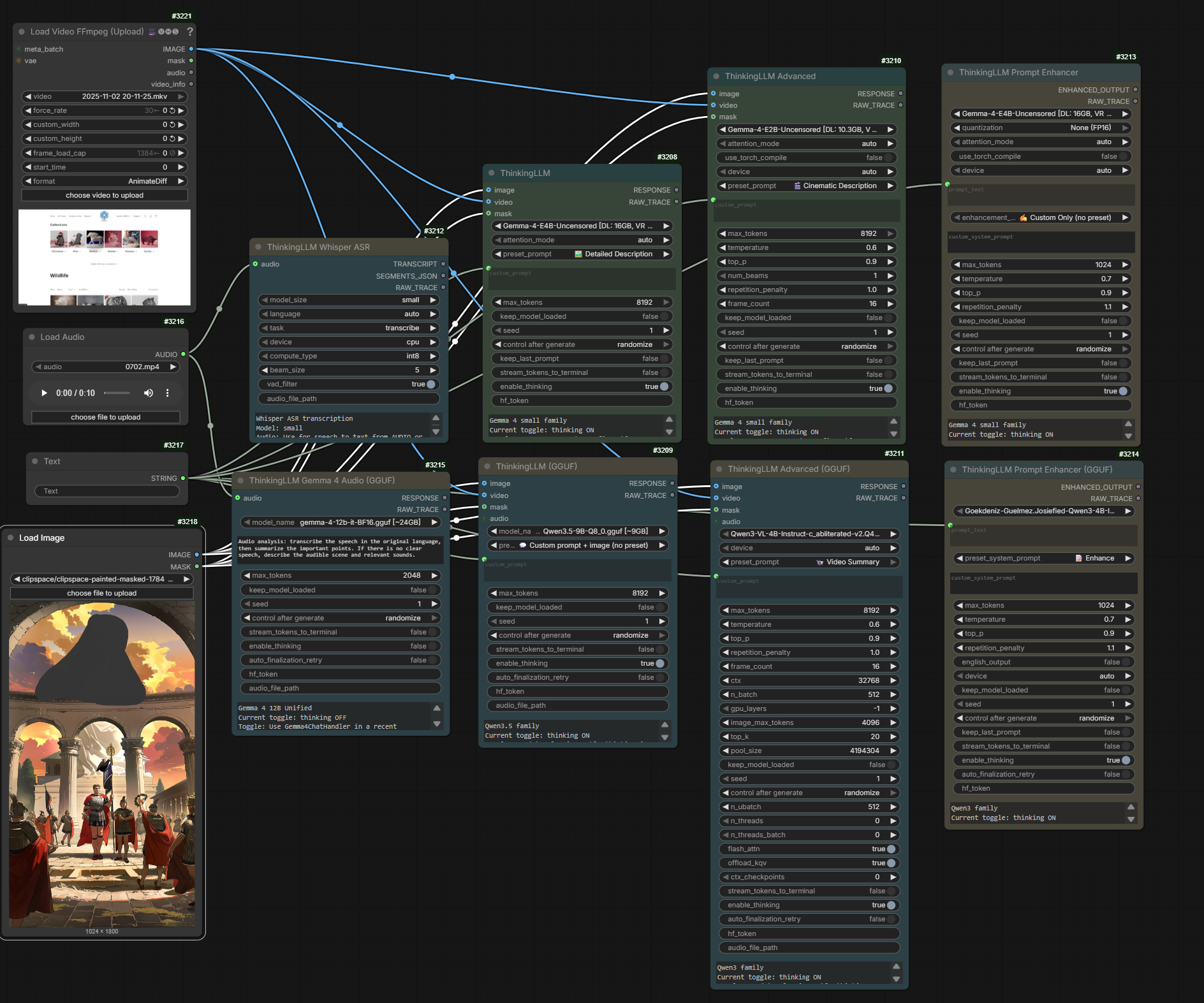
🎥 Prefer a narrated version? Watch the demo on YouTube
What ThinkingLLM adds
Model guidance box
ThinkingLLM nodes add a read-only recommended_settings info box.
- It explains the selected model family and recommended generation settings.
- It does not change your saved widget values.
- For GGUF audio-capable nodes, it tells you whether the selected model actually supports audio.
- In Advanced GGUF nodes, if you connect or expose audio for a model without known audio support, the box warns you instead of silently implying that audio will work.
The Thinking Toggle
Every ThinkingLLM node exposes an enable_thinking toggle.
- When it is on, the model may reason internally before answering. That can make a run take longer.
- For easy prompts, the model can still decide that explicit reasoning is unnecessary and answer directly. That is not a bug. It is a feature.
- When it is off, the node sends a
/no_thinkstyle directive to discourage visible reasoning and push a more direct one-shot answer.
Live token streaming
Enable stream_tokens_to_terminal to print tokens into the ComfyUI terminal as they arrive.
This is useful when:
- a prompt seems stuck and you want to see whether the model is actually working
- you want to debug a bad prompt while it is going wrong
- you want to understand whether the model is thinking or simply producing a long answer
Raw trace output
Each node returns a second string output named RAW_TRACE.
- The main output is the cleaned answer for downstream workflow use.
RAW_TRACEpreserves the raw generation stream, including visible thinking blocks when the model emits them.
That makes it possible to inspect what the model thought about the prompt while still keeping the primary output clean.
Audio support
Audio is available through dedicated nodes so the model list stays honest:
ThinkingLLM Gemma 4 Audio (GGUF)for Gemma 4 audio-capable models.ThinkingLLM Whisper ASRfor reliable speech-to-text transcription throughfaster-whisper.
The Advanced GGUF node also exposes optional audio, but this is for power users. Use the info box before assuming a model can hear audio. Normal Qwen/Qwen-VL models are not audio models.
Nodes
Transformers / HF nodes
This is the recommended default path.
ThinkingLLMThinkingLLM (Advanced)ThinkingLLM Prompt Enhancer
The HF path is the most straightforward option for Windows and Linux when you want the fewest install complications.
HF tokenizer note: some Gemma and Qwen variants need sentencepiece or tiktoken available in the ComfyUI Python environment. ThinkingLLM now declares those dependencies and will attempt to install them automatically if a tokenizer backend is missing at first load.
GGUF / llama.cpp nodes
ThinkingLLM (GGUF)ThinkingLLM (GGUF Advanced)ThinkingLLM Gemma 4 Audio (GGUF)ThinkingLLM Prompt Enhancer (GGUF)
The GGUF path requires a multimodal-capable llama-cpp-python build. The normal PyPI package may not include the chat handlers needed for Qwen vision, Gemma 4, or MTMD audio. On Linux, ThinkingLLM auto-checks this at first GGUF use and attempts an automatic install of a matching JamePeng backend. Use the setup notes in docs/LLAMA_CPP_PYTHON_VISION_INSTALL.md if you need to override the wheel/package source.
Workflow tips
- Pre-process input images — use a resize or scale node before ThinkingLLM so large images don't blow up the context window.
- Display the output — connect RESPONSE or ENHANCED_OUTPUT to a Show Text or Show Anything node to see the generated text in the UI.
- Inspect reasoning — connect the RAW_TRACE output to a second Show Text node to see what the model was thinking.
- Use the dedicated audio nodes first — Gemma 4 Audio is for audio understanding; Whisper ASR is for transcription. The Advanced GGUF audio input is intentionally more flexible, but the info box will warn you when the selected model has no curated audio support.
Supported models
ThinkingLLM supports these model families out of the box, with pre-configured entries in hf_models.json and gguf_models.json.
Qwen — Vision-language (HF)
- Qwen3.5 4B / 9B
- Qwen3-VL 4B / 8B (Instruct, abliterated, unredacted)
- Qwen3-VL 32B Heretic
- Qwen2.5-VL 3B / 7B
Qwen — Vision-language (GGUF)
- Qwen3.5 4B / 9B / 27B (Q4 K M through BF16)
- Qwen3-VL 4B / 8B / 32B (Instruct, abliterated, thinking)
- Qwen2.5-VL 3B / 7B
Qwen — Text-only (HF)
- Qwen3 0.6B / 4B / 8B
- Qwen3.5 4B / 9B (base + heretic + uncensored)
Qwen — Text-only (GGUF)
- Qwen3 4B / 8B (abliterated, Josiefied, base)
- Qwen3.5 4B / 9B / 27B (base + uncensored HauhauCS)
Gemma 4 — Vision-language (HF)
- Gemma-4-E2B-it / Uncensored
- Gemma-4-E4B-it / Uncensored
- Gemma-4-12B
- Gemma-4-26B-A4B-it / Heretic
- Gemma-4-31B-it
Gemma 4 — Vision-language (GGUF)
- Gemma-4-E2B / E4B (Q4 K M through BF16, uncensored)
- Gemma-4-12B-it (Q4/Q5/Q6/Q8/BF16/UD-Q4)
- Gemma-4-26B-A4B-it (Q4 K M through BF16)
- Gemma-4-31B-it (Q4 K M through BF16)
Gemma 4 — Audio (GGUF)
- Gemma-4-E2B / E4B when present in the GGUF multimodal catalog
- Gemma-4-12B-it via
unsloth/gemma-4-12b-it-GGUF
Use ThinkingLLM Gemma 4 Audio (GGUF) for the clean audio-only interface. Gemma 4 audio currently depends on a recent multimodal llama-cpp-python/Gemma4ChatHandler build, so check RAW_TRACE if audio behaves unexpectedly.
Whisper — ASR
- tiny
- base
- small
- medium
- large-v3
- distil-large-v3
Use ThinkingLLM Whisper ASR for transcription. It accepts a connected ComfyUI AUDIO input or an audio_file_path pointing to M4A, MP3, WAV, FLAC, or any FFmpeg-readable audio file. The node uses faster-whisper; first use may download the selected Whisper model into the Hugging Face cache. The default is small on CPU with int8, which is slower than CUDA but reliable on Windows; switch to CUDA once the local CTranslate2 CUDA runtime is confirmed working.
Gemma 4 — Text-only (HF)
- Gemma-4-E2B-it / Uncensored
- Gemma-4-E4B-it / Uncensored
- Gemma-4-12B
- Gemma-4-26B-A4B-it / Heretic
- Gemma-4-31B-it
Local GGUF models placed in models/LLM/GGUF/ with a matching mmproj file are auto-discovered. Pre-configured entries live in hf_models.json and gguf_models.json.
Quick install
ComfyUI Manager (recommended)
- Open ComfyUI Manager → Install via Registry
- Search for
ThinkingLLM - Click Install
Manual install
cd ComfyUI/custom_nodes
git clone https://github.com/goodguy1963/ComfyUI-ThinkingLLM.git
cd ComfyUI-ThinkingLLM
pip install -r requirements.txt
For GGUF vision support, follow docs/LLAMA_CPP_PYTHON_VISION_INSTALL.md.
Model locations
Models are discovered automatically.
- HF models:
ComfyUI/models/LLM/Qwen-VL/ - GGUF models:
ComfyUI/models/LLM/GGUF/
For local GGUF models, keep the matching mmproj file beside the model file.
Platform notes
- HF is the recommended default path and is the simplest cross-platform option.
- GGUF on Windows needs a matching
win_amd64vision-capable wheel. - GGUF on Linux now auto-installs a matching backend on first use when possible. Override with
THINKINGLLM_LLAMA_CPP_LINUX_WHEEL_URLorTHINKINGLLM_LLAMA_CPP_LINUX_SPECwhen your server needs a different build. - GGUF audio needs an audio-capable multimodal backend.
Gemma4ChatHandleris used for Gemma 4. - Whisper ASR needs
faster-whisperand FFmpeg. The node returns an install hint iffaster-whisperis missing. - Flash Attention support is best on Linux. The nodes fall back when it is unavailable.
- The thinking toggle works best with Qwen3.5 and Qwen3 style models. Other architectures may ignore the steering.
FAQ
Why does the node sometimes answer quickly and sometimes take longer?
When thinking is enabled, the model may decide to reason before answering. For easy prompts it may skip explicit reasoning. That is expected behavior.
How do I see what the model was thinking?
Use the second RAW_TRACE output, or enable live terminal token streaming.
How do I debug prompts that seem bad or stuck?
Turn on stream_tokens_to_terminal. It is there specifically so you can see the generation live and catch bad prompt behavior sooner.
Credits and fork lineage
This fork preserves the GPL-3.0 lineage of its predecessors.
- Deaquay/ComfyUI-Qwen3.5-Uncensored
- huchukato/ComfyUI-QwenVL-Mod
- 1038lab/ComfyUI-QwenVL
- Qwen Team (Alibaba Cloud)
- JamePeng/llama-cpp-python
- comfyanonymous/ComfyUI
Maintainer: goodguy1963
Planned repo: goodguy1963/ComfyUI-ThinkingLLM
License
GPL-3.0. See LICENSE.
Run ComfyUI workflows without the setup
No installs, no CUDA version roulette, no GPU sitting idle on your bill. Bring a workflow and run it in the browser.